Most brand voice templates are PDFs full of adjective tables. You fill them in, walk away with "bold, authentic, warm," and the next week you're staring at a blank doc again. The adjectives didn't help. They never do. Adjectives describe a voice — they don't constrain one.
If you're searching for a brand voice template, you're probably already past the discovery stage. You have an offer, a product, a personal brand, or a client engagement, and you need a document that does real work — that you can paste into ChatGPT and have it sound like you, that you can hand a contractor and have them sound like you, that you can come back to in eight months and still recognize as the thing you meant.
This post gives you that template. It's eleven fields. It's a single markdown block, copy-pasteable, with example fills below. Skip to it if you want — section 3.
The rest is why those eleven fields, why the standard ones don't work, and how to fill yours without producing the same useless adjective soup everyone else does.
1. Why most templates fail
The default brand voice template is structured around the wrong artifact. It asks: describe your brand's tone in three adjectives. Pick a brand archetype. Choose your voice on a scale from formal to casual.
These produce descriptions of a voice you haven't written yet. They're after-the-fact. The output is a paragraph that sounds like a marketing deck, not a tool you use at the keyboard.
The test for whether a template is real: can you paste it into an AI tool, write a paragraph against it, and tell whether the paragraph passes? If the only way to check is "does it feel bold and authentic?" — the template hasn't constrained anything. It's a vibe document.
Real constraint looks like:
- A signature line you'd actually write.
- A list of words you'd never use, even if a prompt suggested them.
- A sentence rhythm — short, short, long. Or: long with three commas, then a stop.
- A belief you'd defend on a podcast that nobody else in your space holds.
- The way the voice changes (or refuses to change) when it's selling something.
That's eleven different things, and adjectives don't capture any of them.
2. The eleven fields that actually make a voice template usable
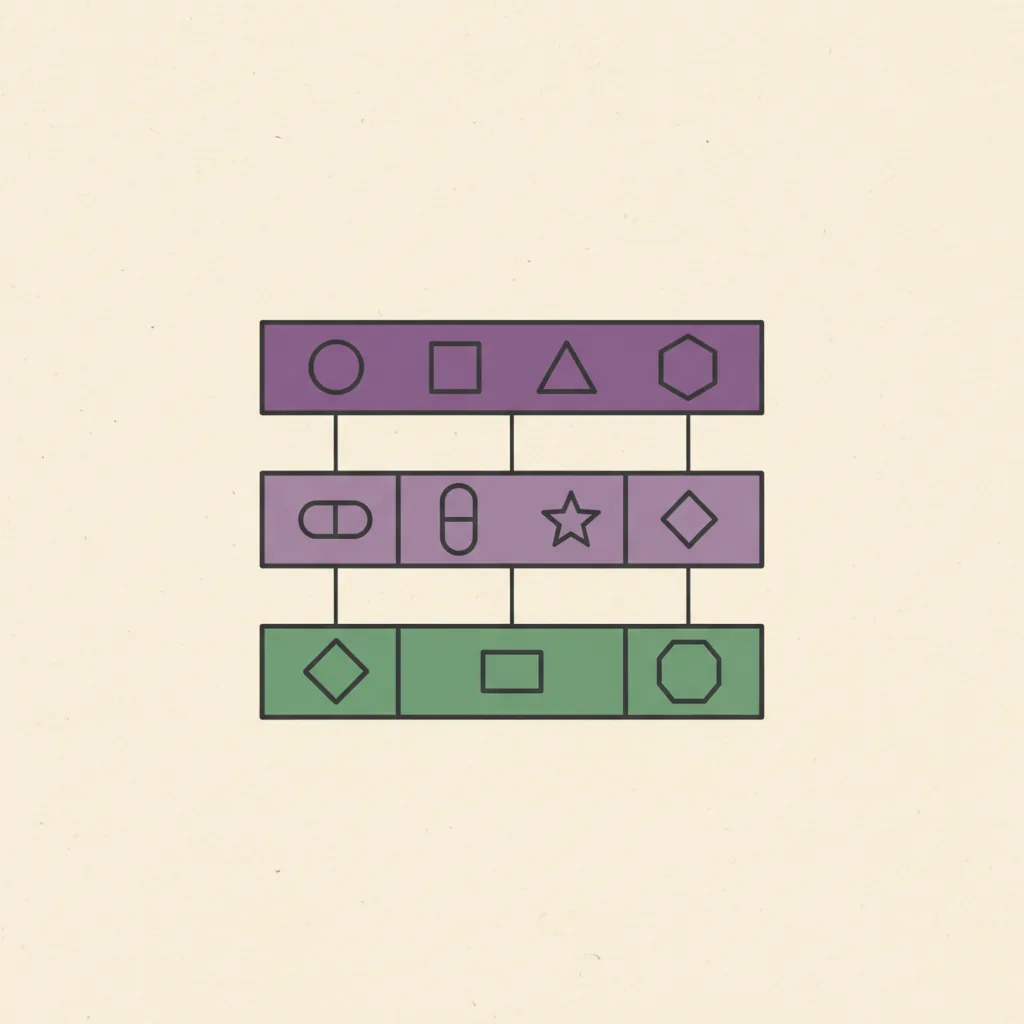
A working template has three layers — foundation, expression, conversion — and eleven fields across them. Every one of them either constrains output (the writer can do this) or rules things out (the writer cannot do this). Both kinds of work.
Foundation (who's actually speaking)
Expression (how it travels)
Conversion (under pressure)
Eleven fields. Three of them (5, 7, 11) are doing more than half the work — and most templates skip all three.
3. The template
Copy this. Paste into Notion, a markdown file, or directly into your AI tool's system prompt. Fill it from the prompts in section 4. Example fills are inside, paraphrased from real Mirror sessions — your fills will look nothing like these and that's the point.
That's the template. Eleven fields, one file. The example fills above are paraphrased from real Mirror sessions to show what completed cells look like — yours will be different in every cell.
4. How to fill it (prompts that actually work)
The fields aren't the hard part. The questions you ask yourself to fill them are. Three to five prompts per section, in order:
| Field | Self-prompt to surface it | Example fill (paraphrased) |
|---|---|---|
| Tempo | Read three of your texts aloud — do they run, or stop? | Short. Hard stops. Asymmetric pacing — long observation, short verdict. |
| Signature line | What sentence have you written more than once? | Voice is downstream of worldview. |
| Words yours | What words do you reach for that nobody else around you uses? | Compound. Operator. Layer. Excavate. Substrate. |
| Words never yours | What words make you flinch when others use them in your space? | Delve. Unleash. Authentic. Journey. Embrace. |
| Belief / contradiction | What do you keep arguing — even with yourself? | Most advice on voice produces adjectives, not voices. |
For tempo / rhythm:
- Read the last three things you wrote. Which sentence shape repeated?
- When you talk, do you finish sentences or trail? (Trailing is data.)
- Where do you naturally pause — beat, comma, line break, or full stop?
For register / default tone:
- If a stranger overheard you explaining your work at dinner, what's the texture — not what you said, the texture?
- What tone do you slip into when you're tired and not performing?
- What register do you actively avoid, and what's the cost of avoiding it?
For signature line:
- What sentence have you written more than once across different posts?
- What line, if a reader saw it without your name, would they still know was yours?
- Don't write a tagline. Write a cadence.
For yours / never yours words:
- Search your last 10,000 words. Which non-trivial words appear repeatedly?
- Which words make you flinch when you see them in your own draft?
- The flinch is the data. Trust it.
For belief / wound / contradiction:
- Belief: What do you keep being slightly wrong-footed by, because you assumed everyone agreed and they don't?
- Wound: What have you been told you do that you privately think is the asset, not the problem?
- Contradiction: What's true about your work and your life that you wouldn't say in a podcast and also wouldn't fix?
For conflict-handling, per-platform, conversion:
- Find the last time someone publicly disagreed with you. What did you actually do? That's your conflict-handling. Don't aspire — describe.
- For each platform, write three openers in voice before you describe the voice. The describing is post-hoc.
- For conversion: read your last sales page. Did it sound like you? If no — what did it sound like? Name the stranger. Then write the version that sounds like you instead.
5. How to use the filled template
The template earns its keep when it leaves the document and starts shaping output. Three places:
As an AI system prompt. Paste the whole brief into ChatGPT's custom instructions or Claude's system prompt. Add: "Write in this voice. If you produce any banned word, rewrite. Match the signature line's rhythm." The model now has constraints — the kind it can actually obey. Adjective-only prompts can't be obeyed because there's nothing to check against.
As a content brief. When you brief an editor, copywriter, or agency, hand them this file. Ask them to deliver the first draft with the banned-words list satisfied and the signature line audible somewhere. You'll get back work that sounds like you on the first try, not the fourth.
As a self-check. Before publishing, scan your draft against fields 4 and 5 (yours / never yours) and field 3 (signature). If none of your words appear and the rhythm has gone uniform, it's not your voice yet. Rewrite — usually one paragraph fixes it.
6. When the template breaks down
The template breaks when the fills go shallow. Specifically:
- Tempo as "varied" — varied isn't a tempo. Pick the actual shape. Short-short-long. Or: long, then a stop.
- Words-that-are-yours filled with industry jargon — jargon isn't yours, it's everyone's. Texture words are the asset.
- Belief that nobody would actually disagree with — "I believe in helping people" isn't a belief. It's a wallpaper. The belief should make at least one peer mildly uncomfortable.
- Wound left blank — the most common failure. The wound is the layer the voice is speaking from. If it's blank, every sentence loses 20% of its weight.
- Contradiction "fixed" — if you write "I say X but I'm working on doing X" you're hiding the contradiction, not naming it. The honest contradiction is the one you've decided to keep.
Most of the time, the template feels impossible to fill not because the layout is wrong but because the question is the hard part. Sitting down cold and writing your wound, your belief, the words that are physically yours — most people can't. Not because they don't know. Because nobody has asked the question that surfaces it.
7. The adaptive version
Filling this in cold is hard. The questions matter as much as the slots — the slots are obvious once you see them, but the questions that pull a real wound or a real signature line out of you don't fit on a static page. Static templates assume you already know what to write under "belief." If you knew, you wouldn't need the template.
The Mirror is the version of this template that asks the questions for you. It's a one-time productized session at /the-mirror — twenty minutes, nine adaptive questions, $27, and the output is the same eleven fields, fully filled, derived from what you actually answered. Same brief. Same markdown export. Different way of arriving.
You can do it the static way. The template above works — many people will fill it in over a weekend and ship something genuinely useful. You can also do it adaptive, in twenty minutes, with the questions handed to you in real time based on what you just said.
Either way, the artifact is the same shape: one markdown file, eleven fields, paste-anywhere. The template you've used to brief AI tools, contractors, and your own next draft. The thing that survives contact with actual writing.
If you'd rather try the adaptive version of the same eleven fields, that exists. If not — section 3 is yours. Take it. Fill it. Use it.