
Most advice on how to find your writing voice ends in an adjective list. Bold, authentic, warm, conversational. Pick three, write them on a sticky note, congratulations.
That advice is why you are still searching.
Adjectives describe a voice you already have. They cannot produce one. The exercises that ask you to "find words that describe your tone" are useful for someone who has already published for ten years and needs to name what's been happening. They are useless for everyone else — the founder shaping a first offer, the coach building a personal brand, the operator who knows exactly what they would say in a meeting and loses it the moment they open the doc.
This piece is for the everyone-else group. The premise is simple. Voice is not something you brainstorm. It is something you excavate.
What "voice" actually means
Voice and tone get confused constantly, and the confusion is the reason most advice fails.
Tone is the costume. It changes by context — formal in a board memo, loose in a Slack message, careful in a customer email. Tone is a choice you make per piece.
Voice is the person wearing the costume. It does not change by context. The same person writes all four of those messages, and if you read them side by side you can tell. Their tempo, what they notice, what they refuse to say, where they hesitate, where they land — that is voice.
Most "find your brand voice" frameworks treat voice as a tone-picker. Pick three adjectives, define the do/don't list, write the brand bible. The result is a costume rack. No person inside it.
Why the standard exercises fail
Look at the top advice that ranks for this keyword. It is variations of the same five moves: read more, write more, mimic writers you admire, find your influences, stay consistent. None of it is wrong. All of it is downstream.
Reading more trains style. Writing more produces volume. Mimicking writers you admire borrows their cadence and lets you hide behind it for another two years. Finding your influences is a useful exercise for someone who already knows who they are on the page. Consistency is what you do after you have a voice, not the thing that gives you one.
The bigger problem: every one of those exercises requires the thing it claims to produce. They assume the voice already exists and just needs surfacing through repetition. For a working novelist with three drafts in a drawer, fine. For someone who has not been performed online yet, this is asking a stranger to learn their own face by looking in a fogged mirror for a decade.
There is a faster path. It starts by acknowledging that voice has layers underneath it, and the standard exercises only ever touch the top one.
The six layers underneath voice
Voice is not a single thing. It is a stack. The Mirror's framework — the one the session walks through — names six layers, each of which has to be excavated for the voice above it to hold.
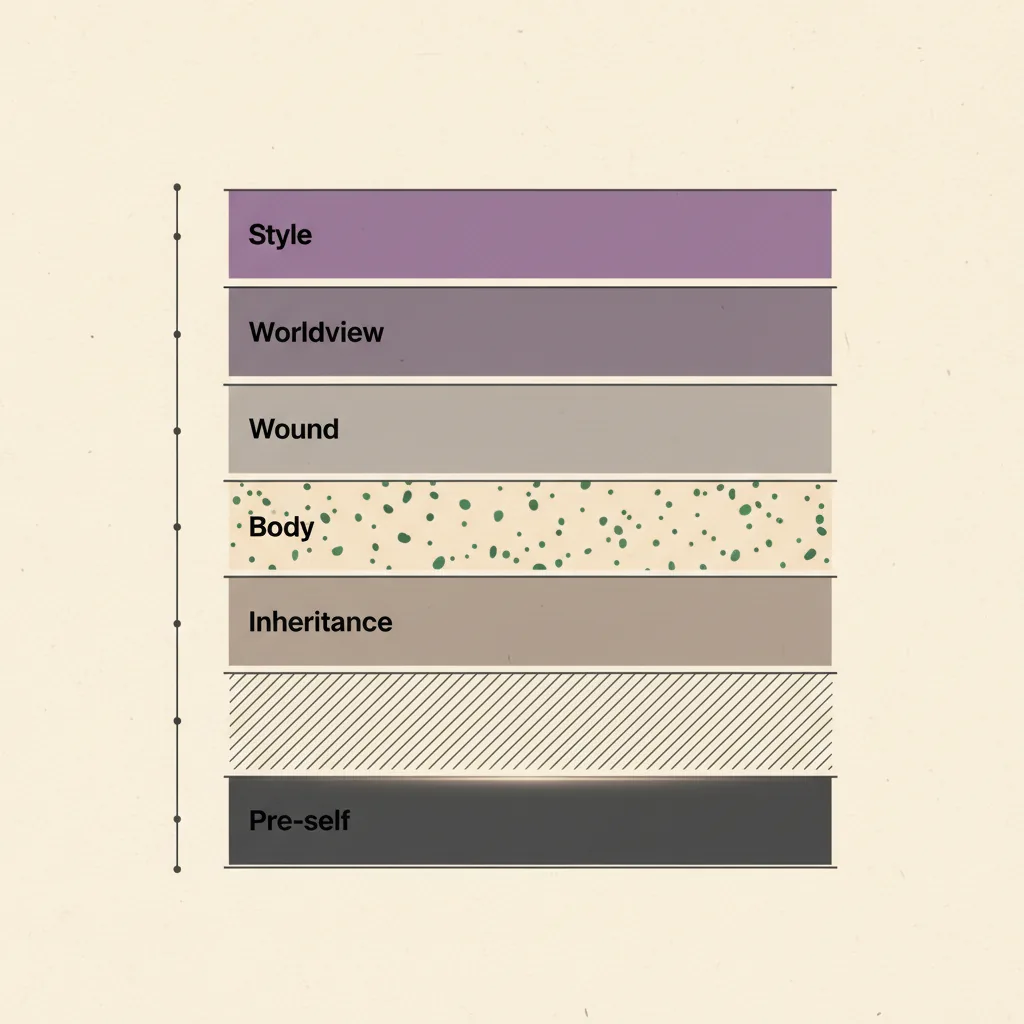
Style is the surface. Sentence length, punctuation, whether you use the semicolon, whether you trust a one-word paragraph. This is what most "find your voice" advice talks about, and it is the layer that changes most easily under pressure. Borrowable. Imitable. Not yours by default.
Worldview is the architecture under the style. What do you believe that most people around you don't? Where does your mind go when something breaks? When two people give you opposing advice, which one feels obviously correct, and which one feels like a polite person trying not to upset you? The worldview decides which sentences you reach for before you reach for them.
Wound is the thing that speaks through everything you write. What have you never quite been believed about. What do you want that you've never said out loud. This is the layer most advice will not name, because it sounds like therapy. It is not. It is the engine. Voice that does not touch the wound stays decorative.
Body is rhythm. Where you hold tension, how your nervous system moves before your mind does. Some people write in long inhales — clauses stacking, comma after comma, until the breath ends and the period lands like a sigh. Other people write in short snaps. Both are nervous systems. Sentence rhythm is body rhythm rendered visible.
Inheritance is the deepest signal. What you carry that isn't yours. The cadence of a parent. A grandparent's silences. A first language sitting underneath your second one. Things you feel before you were taught to feel them. The voice that has not done this work sounds like everyone in the writer's family. The voice that has done it sounds like only the writer.
Pre-self is the layer underneath the layers. Who you were before everything happened to you. What was already there. Most people have a few minutes of access to this — usually in dreams, in the first thirty seconds after waking, sometimes mid-conversation when something true slips out. The most alive version of your voice lives here. The standard exercises do not even know to ask.
You don't need to memorize the names. You need to notice that the layers exist, and that the conventional advice operates only on the first one.
Things you can do alone today
You don't need a session to start. Here are five exercises that bypass the adjective trap. Do any one. Don't do them all in a row — they ask different things.
Write the same observation three ways. Pick any small thing — the way someone sat in a meeting yesterday, what your apartment sounded like at 6am. Write it once flat and reportorial. Write it again as though you were trying to convince someone of something. Write it a third time with no audience at all, like a private note. Read all three out loud. One of them will cost you more than the other two. That one is closest to your voice.
Read your old texts to a trusted reader. Open a thread with someone you write to without performing — a sibling, a close friend, an old collaborator. Read ten of your messages out loud to someone else who knows you. Watch their face for the one where they say "yeah, that sounds like you." Do not edit it. Study it. That sentence has all the information.
Find the line you flinch at. Write three pages on something you actually care about, with no plan to publish. Then read it back. Mark every place you instinctively want to soften, qualify, or delete. The flinches are the layer. Underneath every flinch is a sentence you would have written if you trusted the reader. Rewrite without the flinches. That draft sounds more like you than anything you've ever published.
List what you refuse to say. Forget what to put in. Make a list of words, phrases, and moves you would never use. Authentic. Disrupt. Game-changer. Hot take. Just dropping in. The negative space defines you faster than the positive one. Most voice advice is additive. The fastest excavation is subtractive.
Notice your inheritance. Read three paragraphs of writing by someone you grew up with — a parent's email, a sibling's text thread, an old letter. Find the cadence you share. Find the cadence you've spent your whole life writing against. Both are inheritances. Both shape the voice. Naming them is half the work.
These cost nothing but attention. Done honestly, any one of them produces more than the average month of journaling.
When you've gone too shallow, when you've gone too deep
There are two failure modes.
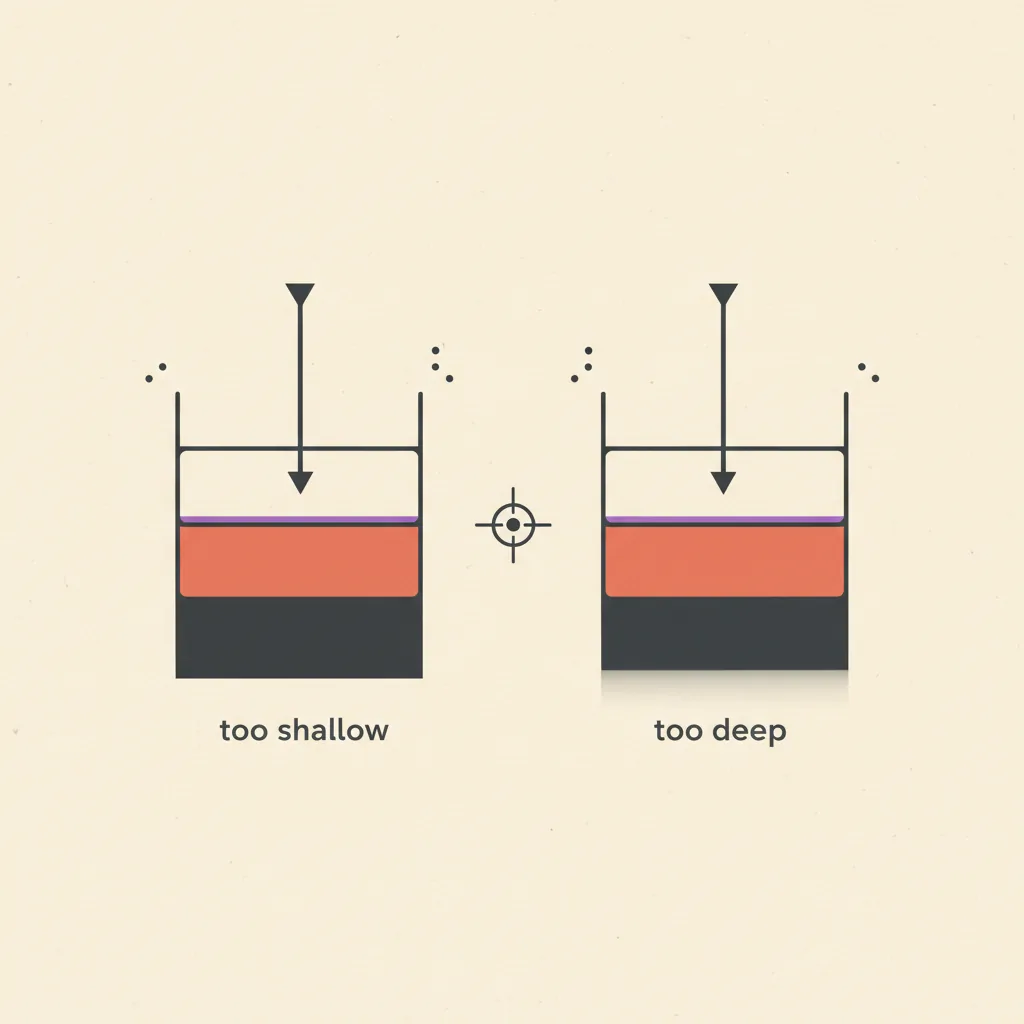
Too shallow: you finish an exercise and walk away with words like direct, warm, conversational. The output looks like a Pinterest board for a brand voice. It will not survive contact with a blank page on a hard day. If your output is adjectives, you have stopped at style. Go back. Ask why.
Too deep: you spend three hours excavating childhood and come out with something that reads like a memoir, not a voice. Voice is the part of you that shows up in every sentence — the email, the LinkedIn post, the customer note, the napkin. If your excavation only describes the version of you on retreats, you've gone past voice and into self-portrait. Voice has to render.
The right depth is the one where you can say: I see the layer underneath the style, I can feel how it shapes my sentences, and I can write a Tuesday afternoon Slack message that still sounds like it came from there.
Find it once, compound it forever
Most people do voice the slow way. Two years of posting in a borrowed tone, six months of feeling vaguely off, a quiet retrofit, another two years of half-hearted publishing while they figure out what changed. Five years to land somewhere that was already true on day one.
The math against that is simple. Every piece of writing you publish trains the audience to expect a specific voice. If the early voice is borrowed, you spend the next decade either compounding the borrowed one or doing the painful work of swapping it out under live traffic. Founders and coaches do this constantly. It is the most common reason a personal brand quietly dies in year two — the voice the audience signed up for is not the voice the writer can sustain.
The argument for getting it right early is not perfectionism. It is leverage. The voice you decide on before you publish is the voice that compounds. Every essay reinforces it. Every post sharpens it. Every customer reply is consistent. The AI tools you use later — the prompts, the custom GPTs, the content systems — all inherit it cleanly because there is something coherent underneath them to inherit.
A voice that has been excavated once survives platform changes, model changes, audience changes, and the slow drift of taste. A voice that was assembled from adjectives does not.
The faster path
If you want to do the excavation alone, the exercises above will get you most of the way. They are real work. Done honestly across a few weeks they produce something the standard advice does not — not a description of your voice, but the layer underneath it.
If you want it done in one sitting instead of five years, that is what The Mirror was built for. Nine adaptive questions, each one written from the answer before it, walking through the six layers in about twenty minutes. The output is a voice card, an expression guide, a conversion guide, a sample piece written in your voice, and a markdown export you can paste into any AI tool from now on. No transcripts required. No three months of past content to feed it. Built for the version of you that hasn't been performed online yet.
The point of either path — alone or in a session — is the same. Stop describing your voice. Find what is doing the describing.