
Every tutorial on training AI to write like you opens the same way. Step one: gather thirty thousand words of your writing. Step two: paste it into a custom GPT. Step three: refine.
If you have thirty thousand words of your writing in one place, you don't need this post. You're a journalist or a novelist or a six-year LinkedIn poster, and the corpus solves itself.
Most people don't have that corpus. They have an email account, a few Slack threads, two abandoned Substacks, and the fragments of a personal brand they're still shaping. The standard tutorial assumes the asset you're trying to build already exists. That's the problem.
This post is for the other 90%. The premise is simple: you can train AI to write in your voice without uploading transcripts you don't have. You just need a different input.
1. The premise everyone gets wrong
The category-defining mistake of every "train ChatGPT to write like you" guide is treating voice as a fingerprinting problem. Feed the model enough samples and statistical pattern-matching will surface the underlying style.
This works in linguistics labs. It does not work for a person who hasn't been talking online for five years.
The reason isn't technical. It's that the corpus people imagine they have rarely exists in shape the model can use. Slack messages aren't your voice — they're you accommodating six different audiences across a workday. Old emails aren't your voice — they're you being professional. Comments under other people's posts aren't your voice either. They're you reacting.
What you actually want when you say "make AI sound like me" is the version of you that exists when you're choosing every word on purpose. That version produces maybe four documents a year. It is not a corpus. It is not statistically extractable.
The thing the tutorial industry never says out loud: there's a second input that works better than samples, and it doesn't require you to have written anything at all. It requires you to be specific about six things.
2. What actually makes AI sound like a person
Voice is not a fingerprint. It's a small number of constraints applied consistently. Here are the six that matter — paraphrased generously, because the specifics belong to the brief, not the post.
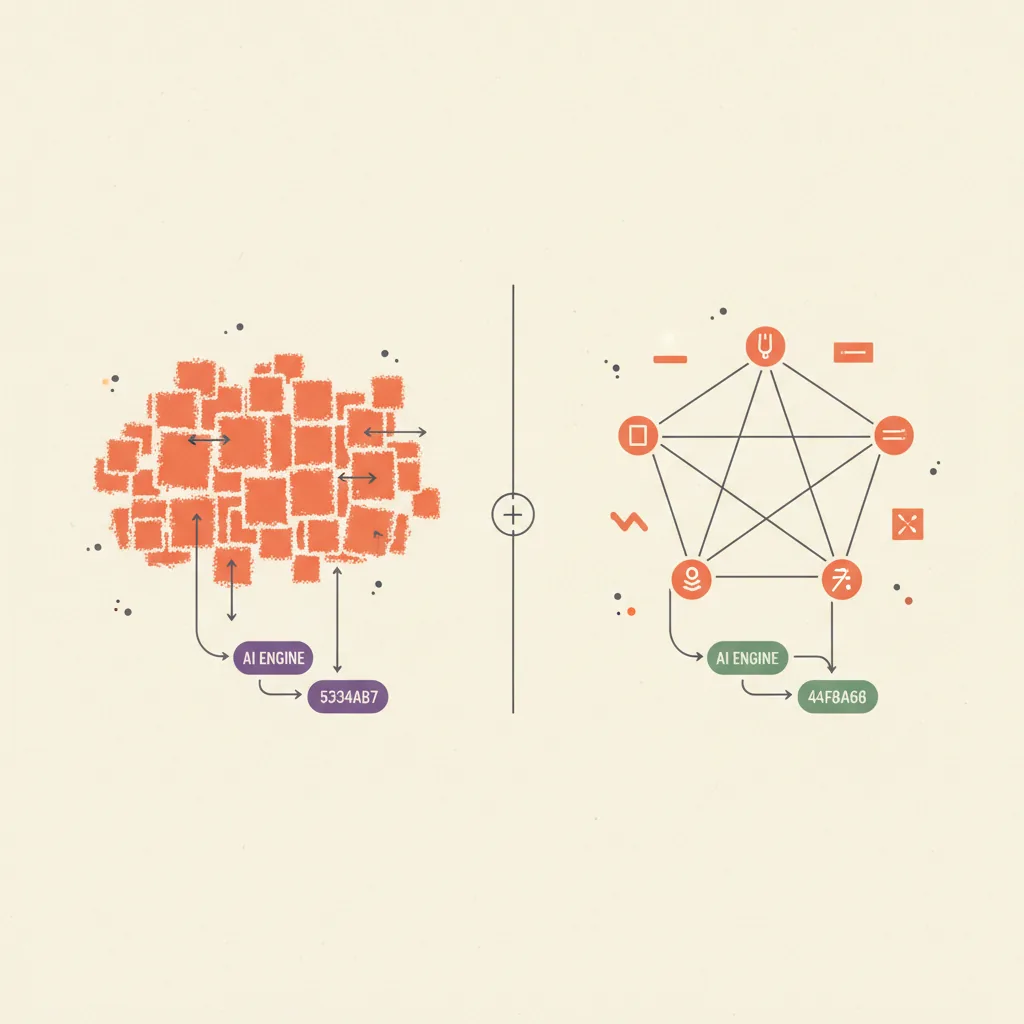
Tempo and rhythm. How long are your sentences, on average? Do you stack short ones for emphasis or run long ones to hold tension? The difference between Hemingway and Sebald is mostly here. Most people have a tempo signature they don't realize they have.
Register. Where do you sit on the formal-to-blunt axis? Closer to the lecture hall or to the kitchen table? Register is what makes "we should consider" sound like a stranger and "here's the thing" sound like you.
Lexicon — yours and never-yours. Every voice has fifty words it leans on and twenty it would never say. The never-yours list is more diagnostic than the yours list. If a draft lands on your desk and contains the word "delve," you know immediately it isn't yours.
Signature line. Most people have a sentence shape they default to under pressure. Conditional. Declarative. Question. Whatever it is, it shows up across email, slides, and texts. Naming the shape gives the model a target.
Worldview. What you believe that most people in your space don't. Voice without worldview reads as hollow performance. The contrarian premise is the thing the writing is for — without it, every paragraph drifts toward consensus.
Default move under pressure. What you do when the writing has to land — pause for emphasis, undercut yourself, escalate, stop short. This is the layer everyone skips. It's also the one that separates "sounds like a human" from "sounds like that human."
These six are the constraints. The voice brief is what happens when you write them down.
3. The structured voice brief — anatomy
A voice brief is a markdown file. About 800–1500 words. It has a stable structure:
| Dimension | What it tells the AI | Example constraint |
|---|---|---|
| Tempo | How fast sentences run vs stop | Short declarative sentences. Hard stops. No comma stacking. |
| Register | Formal vs casual default | Mid-formal. No corporate hedging. No bro-casual. |
| Signature line | A phrase only this voice would write | Voice is downstream of worldview. |
| Words yours | Vocabulary you reach for | Compound. Operator. Layer. Excavate. |
| Words never yours | Vocabulary the AI must avoid | Delve. Embrace. Authentic. Journey. |
| Belief / contradiction | The thing the voice keeps arguing | Most advice on voice produces adjectives, not voices. |
Drop that file into the system prompt of any model. Or paste it into the instructions field of a custom GPT. Or put it at the top of every chat. The model now has named constraints to operate under instead of an empty "write in my voice" command.
The cost of generating this once is the cost of being honest about six things for twenty minutes. The cost of regenerating it never comes up — voice doesn't change much. The brief travels.
If you want one built without the introspection lift, The Mirror is the productized version of this exact process — nine adaptive questions, twenty minutes, a markdown brief at the end.
4. A worked example
Here's the same prompt, run two ways. The topic: "explain why most personal brands sound the same." The voice belongs to a fictional consultant named Mara — direct, slightly contrarian, prefers short sentences after long ones.
Version A — sample-based prompt
Prompt: Write a LinkedIn post about why personal brands all sound the same. Here are two examples of my writing: [paragraph 1] [paragraph 2]. Match my voice.
Output:
Most personal brands sound the same because most people are using the same playbook. They read the same gurus, follow the same templates, and post the same five frameworks. The result is a sea of sameness where everyone's bold, authentic, and human — which means nobody is. The fix is to find your unique angle and lean into it. Be specific. Be different. Be you.
That's competent. It's also indistinguishable from forty thousand other LinkedIn posts. The model matched surface features — sentence length, conjunction-light style — and reverted to consensus content.
Version B — voice-brief prompt
Prompt: Use the voice brief at the top of this thread. Write a LinkedIn post about why personal brands all sound the same.
Brief specifies: tempo averages 14 words, with breaks of 4–6 word sentences for emphasis. Worldview: 'the personal brand industry is the problem, not the solution.' Words never yours: authentic, journey, unleash, embrace. Signature line: declarative followed by short clarification.
Output:
The personal brand industry was supposed to help people sound like themselves online. It taught them to sound like the personal brand industry instead. Adjectives crowd in. Bold. Warm. Approachable. You can pick three from a list of twelve. Everyone picks the same three. The problem isn't the platforms or the algorithm. It's that the playbook for being differentiated is itself the most aggressively standardized product in the market. You can't find your voice by completing a worksheet that ten thousand other people completed last Tuesday.
The second one says something. The first one does not. The difference isn't the model — both came from the same one. The difference is which inputs the model had to work with.
5. Why "give it samples and tell it to write like that" plateaus
The sample-based approach is the one Forbes and Medium tutorials default to, and it isn't wrong — it's just shallow. It teaches the model surface features and nothing else.
A few specific ways it fails:
Topic drift. Your samples are usually about one or two domains. Ask the model to write about a third domain and it has nothing to interpolate from. It defaults to the model's house voice, lightly seasoned with your vocabulary.
Length drift. Sample-trained outputs hold for the first paragraph and lose the thread by the third. Without a named tempo rule, the model regresses to mean sentence length.
Confidence drift. The hardest thing for a sample-trained prompt to keep is the worldview underneath. Samples teach what you said. They don't teach why you bothered. The model picks up the cadence and drops the conviction, which is exactly the part of the writing readers are responding to.
The fix isn't more samples. The fix is naming the constraint explicitly. The model is a constraint-satisfaction engine. Give it constraints.
This is the answer to the version of this question we get most often: can't I just prompt ChatGPT to do this? You can try. You'll find that prompting ChatGPT to write in your voice requires you to already know what your voice is — which is the part you came here to figure out. The prompt isn't the product. The brief is the product. The prompt is just the delivery vehicle.
6. When you should not train AI on your voice
There are cases where this whole approach is the wrong move. Three of them:
Your voice isn't formed yet. If you genuinely haven't decided what you believe about your space, generating a brief locks in a placeholder. The brief should reflect the version of you you've actually committed to — not the version you'd like to be performing.
The work needs to be unmistakably hand-made. Personal essays, eulogies, things where the labor is part of the value. A voice brief speeds up content. It doesn't replace presence.
You're writing under someone else's name. Ghost-writing for a client, drafting in a manager's voice, copywriting for a brand that isn't yours. In those cases you need their brief, not yours. The technique is identical. The subject changes.
If none of those apply, the voice brief is the highest-leverage input you can build. You generate it once. Every AI tool you touch for the next decade gets the same brief.
7. The cheaper path
You can write your voice brief by hand. People do. It takes a few hours of honest self-interview, a willingness to say specific things instead of adjectives, and the patience to draft a sample piece that actually demonstrates the rules.
Or you can sit through twenty minutes of structured questions designed to extract those six layers, and walk out with the markdown file ready to paste anywhere. That's The Mirror — $27, one session, the brief you keep forever, the asset every AI brand voice generator says you need without telling you how to build.
Either path works. The path that doesn't work is the one most tutorials hand you: upload a corpus you don't have, or write a one-line prompt and hope the model does the rest. The input is the bottleneck. Fix the input, the rest follows.
If you want the brief without the introspection lift, start a session. If you'd rather build it by hand, the anatomy in section 3 is enough to start. Either way, stop trying to fingerprint a corpus that doesn't exist. Name the six things. The model takes it from there.