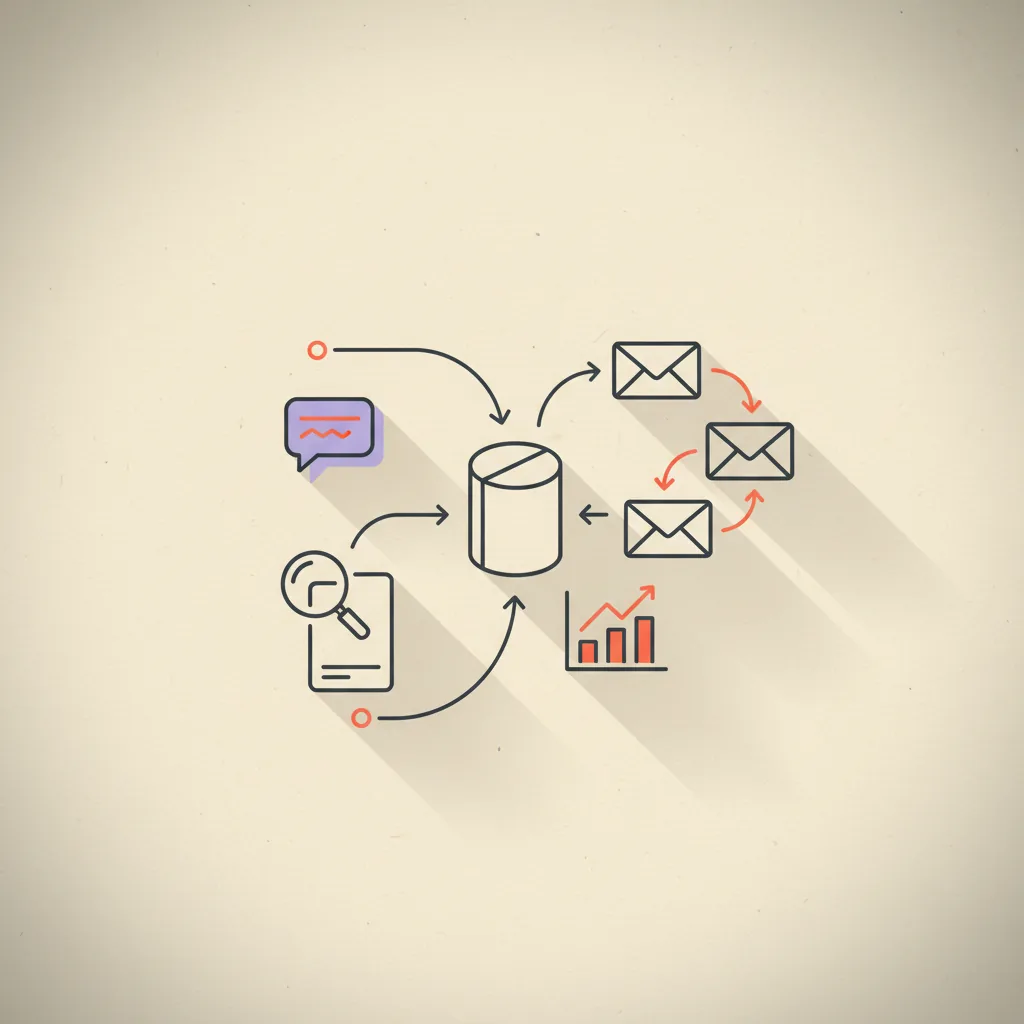
AI for ecommerce covers a real range of capability — personalized recommendations, automated customer support, per-SKU profitability dashboards, AI-generated ad creative, behavior-triggered retention flows, predictive replenishment. The vendors selling each capability have an obvious incentive to make theirs sound like the highest priority.
This is a skeptical operator view of where AI for ecommerce actually moves margin. It is written for brands who have already built the basics (Shopify, paid acquisition, basic Klaviyo) and are deciding what to invest in next. The implementations below are ordered roughly by payback speed, not by how much vendors charge for them. The highest-ROI items in this category are consistently the unglamorous ones — Klaviyo flow coverage is less impressive-sounding than an AI recommendation engine, and it pays back faster and compounds longer.
Why is Klaviyo lifecycle the most underbuilt AI for DTC brands?
The default Klaviyo install at most DTC brands is four flows: Welcome series, Abandoned Cart, Browse Abandonment, Post-Purchase. Those four capture roughly 12–15% of revenue.
A properly built long-tail Klaviyo stack — 12+ flows including Replenishment, Win-Back at 90/180/365 days, VIP, Sunset, Birthday, Review Request, Cross-sell, and Back-in-Stock — captures 28–34% of revenue. The difference is 14–20 percentage points of email revenue, on the same list, with no incremental ad spend. On a $3M ARR brand, that math is material.
The AI layer adds behavioral segmentation (who gets which flow based on purchase history and browsing behavior) and creative variant testing across cohorts. Build cost: $4,997–$8,997. Payback is measured in weeks, not months.
The reason most brands have not done this is not complexity. It is priority. Every DTC brand we audit has the same Klaviyo gap.
Does AI customer support hurt CSAT for DTC brands?
AI customer support for DTC means training a model on 12+ months of Gorgias, Zendesk, or Re:amaze tickets and deploying it to handle tier-1 questions — order status, return policy, product questions, discount code issues — across email, chat, Instagram, and WhatsApp. Done well, it deflects 65–78% of inbound volume with a sub-30-second first response. CSAT for AI-resolved tickets typically holds at 4.5–4.7. Tier-2 issues (complex returns, complaints, fraud) escalate to a human with full conversation context already surfaced.
The economics are straightforward: a 3-person support team at $45k each is $135k/yr. A well-built AI support system that handles the majority of tier-1 volume costs $3,997–$8,997 to build and $1,000–$2,000/mo to run. Most brands reduce support headcount from 3 to 1 senior agent who handles escalations and trains the model.
The right tool stack is Gorgias — because it has native Shopify integration — plus an LLM layer on top. Standalone AI support tools that do not connect to Shopify order management lose context on the most common questions.
How does AI creative for paid ads change the testing economics?
AI creative for DTC paid advertising means using LLM tools to generate structured creative briefs, ad copy variants, and hook testing frameworks — not to replace human creative judgment, but to multiply the volume and speed of iteration.
The workflow: AI generates angle hypotheses from product data and competitor research. A human creative director selects and refines. AI generates copy variants in those angles. Human approves. Test runs. AI reads performance and surfaces the pattern behind the winners.
We ran 30 ad variants in one month across a client account, six worked, and the winning pattern did not match what the vendor pages said about creative best practices — which is the point. The manual creative process cannot test at that volume, so the patterns stay invisible.
For DTC brands spending $50k+ per month on Meta and TikTok, better creative testing compounds directly into margin. See how to get cited by AI search for how this same content-velocity principle applies to organic surfaces.
How do replenishment and behavior-triggered win-back flows work?
Replenishment automation uses purchase history and product consumption rates to predict when a specific customer is likely to run out — and triggers a targeted email or SMS before they search for alternatives. For consumables brands (supplements, skincare, pet food, household staples), a well-timed replenishment sequence typically outperforms every other flow in the stack.
Win-back flows target customers who have lapsed at 90, 180, and 365 days since last purchase. The AI layer adds personalization based on what they bought, what they browsed since, and what customers with similar purchase history bought next. A behavior-informed win-back citing specific products substantially outperforms a generic "we miss you" message.
Both flows require clean purchase event data from Shopify. The tooling is Klaviyo for transactional patterns, Klaviyo plus Recharge for subscription-first brands. The implementation depends entirely on the event data being in place — that is the prerequisite, and it is often not. See the E-commerce & DTC industry page for the full Klaviyo coverage we build.
What is per-SKU P&L automation, and why does it change buying decisions?
Most DTC brands know their blended ROAS and overall gross margin. Very few know actual per-SKU net margin when you account for fulfillment cost variance (weight, dimensions, carrier surcharges), return rate per SKU, Klaviyo-attributable revenue per SKU, and ad spend per SKU in the periods leading to purchase.
Per-SKU P&L automation pulls from Shopify (order and return data), your 3PL or fulfillment provider (item-level costs), ad platforms (spend by product), and Klaviyo (email-attributed revenue) into a daily dashboard. The dashboard surfaces two things: SKUs running negative margin that look profitable on the surface — usually because return rates are higher than reported or fulfillment costs are lumped into one line — and SKUs with strong margin that are being underinvested.
We have watched this dashboard inform the decision to cut two SKUs and double ad investment on two others within 60 days of going live, with meaningful blended margin improvement across the catalog. Build is Looker Studio or a custom layer on Supabase. Build time: 2–4 weeks. This is typically the highest-ROI analytics investment available to a DTC brand at this stage.
Should I build AI-personalized product recommendations from scratch?
Personalized product recommendations serve different product suggestions to different customers based on browse history, purchase history, and behavioral similarity to other customers who purchased specific products.
| Tier | Tooling | Right for | Build cost |
|---|---|---|---|
| Basic | Shopify native recommendations | Stores under $500k ARR | $0 — built in |
| Middle | Klaviyo blocks with purchase-history personalization | $500k–$5M ARR · email is primary surface | $0 incremental — already paid for |
| High-end | Vector-similarity rec engine across site + email + post-purchase | $5M+ ARR · personalization is core differentiation | $15–40k build + monthly tooling |
The middle tier is where most DTC brands in this revenue range should spend their energy first. Klaviyo conditional content blocks and product recommendation blocks, properly configured with purchase and browse history, produce measurable lift in email-attributed revenue on product recommendation emails versus generic bestseller blocks. The implementation is a Klaviyo configuration engagement, not a new tool purchase. Most brands already own this capability inside Klaviyo and are not using it.
How do I scope an AI for ecommerce roadmap?
Order matters. Build Klaviyo lifecycle coverage first — that is where the immediate revenue lift lives. Layer AI customer support second, after the historical ticket data is in shape. Add per-SKU P&L automation in parallel because the buying decisions it informs compound monthly. AI creative for paid ads belongs in month 2–3 once the foundational flows are stable. AI personalized recommendations belong last, when you have already harvested the wins from the first four.
We map this for DTC operators in our AI Stack Audit (free, 3 minutes), or take the longer path through Custom Builds where we ship the full operating system as a single phased engagement.