
Most AI sales coaching tools coach the wrong thing. They flag that an AE said "um" 47 times in a 30-minute call, that talk-time ratio drifted to 65/35 instead of the recommended 50/50, that the demo started 3 minutes late. None of those signals lose deals. What loses deals is single-threaded coverage with a champion who has no real budget authority, momentum that died after week three, an unresolved technical objection that nobody wrote down, a competitor mentioned twice and never addressed. Few tools surface those signals well, and the gap is what separates the platforms worth paying for from the ones that just look impressive in a demo.
This post compares the five tools that actually show up in production sales stacks in April 2026 — Gong, Chorus.ai, Fathom, Granola, and Avoma — on the dimensions that matter at the deal level, not the call level. Pricing is current as of late April 2026. The rankings come from active client billing, parallel transcript tests across all five platforms, and the failure modes operators hit at the second QBR. The contrarian thesis runs through every section: most teams overpay for call-level filler-word analysis and underinvest in the deal-level patterns that actually move close rates.
What AI sales coaching tools actually do
Strip away the marketing language and every product on this list does the same four jobs: transcribe the call, summarize the call, flag patterns across calls, and (sometimes) score the deal. The differences are in how well each layer performs and how the dashboard surfaces the output.
- Transcribe — turn audio into searchable text. All five tools clear this bar; transcription is a commodity in 2026.
- Summarize — produce a 2–4 paragraph recap with action items, key decisions, and follow-up tasks. Granola and Avoma are the strongest here; Gong and Chorus optimize for length over readability.
- Flag patterns — highlight that a competitor was mentioned, that a pricing objection went unanswered, that the prospect asked the same question twice. Gong and Avoma are strongest; Fathom barely does this.
- Score deals — produce a deal-level health score that updates as calls happen. Only Gong and Avoma do this seriously. Chorus does it inside the ZoomInfo bundle. Fathom and Granola do not.
The fourth job is where the contrarian thesis kicks in. Deal scoring is the hardest layer to build and the most valuable to operate, but most tools score deals on the wrong inputs — call sentiment, talk-time ratios, demo coverage — instead of on the inputs that actually predict close: number of stakeholders engaged, decision-maker access, momentum velocity, and competitor presence. Even Gong, which is the strongest of the five at deal-level pattern recognition, leans heavily on call-level signals because they are easier to measure.
The 5 production-grade tools
These are the tools that show up in real sales stacks. Other names exist (Mindtickle, Salesify, Hyperbound, Demodesk, Modjo, Read.ai, tl;dv) but most either sit below the production-volume bar or solve a different problem (roleplay, training, lightweight note-taking).
| Tool | Pricing | Sweet spot | Deal-coaching strength | Summary quality | Weakness |
|---|---|---|---|---|---|
| Gong | $1,200–$2,400/seat/yr | Enterprise sales orgs (50+ reps) | Strongest | Verbose, dashboard-driven | Heavy, expensive, slow to onboard |
| Chorus.ai | Bundled with ZoomInfo (~$1,200+/seat/yr equivalent) | Teams already on ZoomInfo | Strong | Comparable to Gong | Locked to ZoomInfo bundle |
| Fathom | Free tier, $19/mo Pro, $29/mo Premium | Solo AEs and tiny teams | Minimal | Decent | No real coaching layer |
| Granola | $14/mo individual, $25/mo team | Mac-native power users, 1–10 reps | Light | Best on the list | Mac-only, no deal-level analytics |
| Avoma | $19–$89/user/mo | Mid-market sales orgs (10–50 reps) | Strong | Strong | Less polished than Gong at the high end |
Per-tool deep dives
Gong — the enterprise default
Gong is the category leader and the default pick for any sales org past 50 reps. The deal-level analytics are genuinely the best on the market: deal-risk flagging, multi-thread coverage tracking, momentum scoring, and manager review tooling that surfaces which deals need intervention this week. The transcript search across the entire org makes "find every call where a competitor came up in the last quarter" a 5-second query.
Where Gong falls short: it is heavy and slow to onboard, the per-seat pricing puts it out of reach for teams under 50 reps, and the summary quality has not kept pace with the lightweight tools — Gong recaps are dashboard-flavored data dumps, not the readable 2-paragraph briefs Granola produces. Pricing in April 2026 typically lands at $1,200–$2,400 per seat per year on negotiated annual contracts, with implementation fees on top. Worth it for big sales orgs; overkill for everyone else.
Chorus.ai — the ZoomInfo bundle play
Chorus.ai is functionally similar to Gong with one structural difference: it is owned by ZoomInfo and bundled with ZoomInfo licenses. If your team already pays for ZoomInfo, Chorus comes in at a meaningfully lower marginal cost. If you do not, Chorus standalone is priced similarly to Gong without the brand recognition or the larger pattern-recognition library Gong built up over the last decade.
Where Chorus falls short relative to Gong: the deal-coaching depth is a step behind, the manager review tooling is less mature, and the bundle dependency means switching off ZoomInfo means switching off Chorus. Pick this if you are already a ZoomInfo customer and the bundle pricing makes the math work; otherwise Gong is the cleaner buy at the high end.
Fathom — the free-tier note-taker
Fathom is the lightest tool on the list. The free tier covers unlimited recording and transcription with basic AI summaries; Pro at $19 a month adds AI action items and CRM sync; Premium at $29 a month adds team features and integrations. For a solo AE running 5–10 calls a week and mostly wanting clean follow-up notes, the free tier is enough.
What Fathom does not do: real deal-level coaching, pattern recognition across calls, manager review tooling, or anything resembling Gong-style risk flagging. The summaries are decent but not the best on the list — Granola edges Fathom on readability. Treat Fathom as a free-tier note-taker that scales to a small team, not as a coaching platform. Sales orgs past 10 reps usually outgrow it within a quarter.
Granola — the Mac-native power tool
Granola is the surprise pick of 2026. It is Mac-only, sits as a native app on the desktop instead of joining calls as a bot, and produces meeting summaries that are noticeably better than anything else on the list — readable, well-structured, with action items that actually match what was said. Pricing is $14 a month for individuals and $25 a month for teams. For a 1–10 person sales team where every rep is on a Mac, Granola is the best summary tool money can buy at this price tier.
What Granola does not do: deal-level analytics, manager review tooling, deal-risk scoring, or any of the coaching infrastructure that Gong and Avoma offer. It is a meeting summary tool, not a coaching platform. The gap is the bet — Granola is wagering that summary quality plus a clean app experience matters more than dashboard depth for small teams. The wager is correct under 10 reps and wrong above 50.
Avoma — the mid-market sweet spot
Avoma is the best-value pick for sales orgs in the 10–50 rep range. Pricing runs $19/user/mo for the Starter tier (transcription + AI notes), $49/user/mo for Plus (deal intelligence, conversation analytics), and $89/user/mo for Business (full coaching platform, manager dashboards). At the Plus tier, Avoma offers most of what Gong does at roughly a third of the price.
Where Avoma falls short: the polish is a step below Gong at the high end. The deal-risk flagging is not as sharp, the pattern recognition library is smaller, and the manager review tooling is more basic. For a 100-rep enterprise sales org, those gaps add up; for a 25-rep mid-market team, they rarely matter. The Business tier is also priced into Gong territory, which is where the value math gets harder to defend.
What good coaching tools should actually surface
The reason most sales coaching produces marginal results is that the tooling optimizes for the wrong signals. Filler words, talk-time ratios, and demo pacing are easy to measure and easy to display on a dashboard. None of them predict whether a deal closes. The signals that do are harder to extract from a single call — they live across a deal cycle and require the tool to track patterns deal-by-deal, not call-by-call.
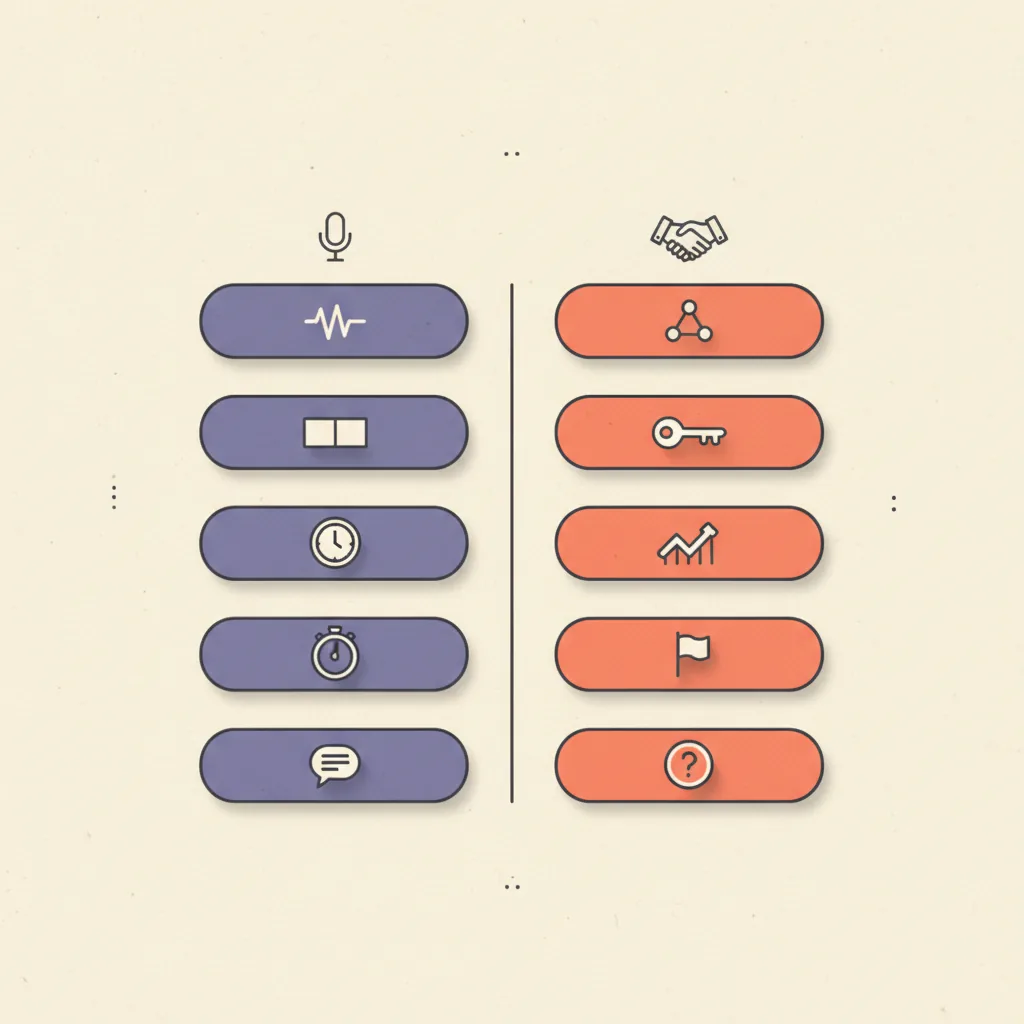
The deal-level signals worth surfacing:
- Multi-thread coverage — how many stakeholders inside the buying org have engaged at all? Single-threaded deals close at roughly half the rate of deals with three or more contacts engaged, yet most coaching tools never flag the contact-count gap.
- Decision-maker access — has the AE actually talked to the person with budget, or only to the champion? Most coaching tools score the champion call as if it were a decision-maker call.
- Momentum velocity — how many days since the last meaningful interaction? Deals that go quiet for 14+ days close at a fraction of the rate of deals with weekly cadence, yet most call-recording tools surface call counts, not gap analysis.
- Competitor presence — was a competitor mentioned, was the AE's response captured, did it land? Gong is the strongest at this; the others mostly miss the second-order question of whether the response actually addressed the concern.
- Unresolved objections — questions raised by the prospect that did not get a documented answer. This is the highest-leverage signal in coaching and the most under-served. Gong does it best; Avoma is improving fast; the others mostly do not.
A coaching tool that flags "your AE said um 47 times" is producing data, not insight. A tool that flags "this deal has gone 19 days without a meeting, the prospect mentioned a competitor twice and the AE did not address it the second time, and your only contact is the technical evaluator" is producing the signal that actually moves close rate. The gap between those two outputs is the entire reason to pay enterprise prices for a coaching platform.
Pricing comparison
Per-seat pricing across the five tools spans a roughly 100x range, from $14/mo to over $2,000/year. The relevant question is not which tool is cheapest but which tier matches the team size and revenue stage.
The shape of the chart matters more than the absolute numbers. Granola, Fathom, and Avoma Starter all sit under $400 per seat per year. Avoma Plus jumps to roughly $600. Avoma Business and Gong sit in the $1,000–$2,400 range depending on negotiation. Below $400 per seat, you get summaries; above $1,000 per seat, you get deal analytics. Avoma Plus at $588 is the only mid-tier option that actually offers real coaching infrastructure at sub-Gong pricing.
Which tool to pick by team size
Team size is the cleanest selection axis because it correlates with both the volume of calls (which determines whether deal-level pattern recognition pays off) and the existence of a manager review process (which determines whether enterprise dashboards get used).
| Team size | Recommended | Alternative | Why |
|---|---|---|---|
| Solo AE / 1–3 reps | Fathom (free) or Granola | Avoma Starter | No need for deal analytics yet; summary quality is the wins |
| 4–10 reps | Granola or Avoma Starter | Fathom Premium | Manager review starts mattering; Granola if Mac-only, Avoma if mixed |
| 10–25 reps | Avoma Plus | Fathom Premium + manual review | Real deal-coaching layer becomes worth the spend |
| 25–50 reps | Avoma Plus or Business | Gong (early) | Cross-deal pattern recognition matters; Avoma still cheaper |
| 50–100 reps | Gong or Avoma Business | Chorus.ai if ZoomInfo customer | Manager review process needs heavier tooling |
| 100+ reps | Gong (or Chorus if bundled) | Avoma Business | Enterprise dashboards, multi-team analytics, depth wins |
A working test for any team in the 10–25 rep range: if your sales managers are not actively reviewing calls weekly today, do not buy Gong. The dashboards do not coach anybody on their own; they need a manager who actually opens them. Avoma Plus is the better starting point because the product is light enough that the discipline of manager review is more likely to take hold. Once that habit exists and the team scales past 50, the upgrade to Gong becomes a real conversation.
Common failure modes
Patterns we see in audits of broken sales coaching stacks:
- Over-reliance on AI summaries — AEs stop taking notes, stop re-reading prior calls, and lose context retention across the deal cycle. By call 11 of a complex deal, the AE knows nothing about the prospect that was not in the last summary.
- Manager review never happens — the team buys Gong, the dashboards generate beautiful reports, nobody opens them. Coaching tooling without manager discipline is shelf-ware.
- Coaching the wrong layer — focusing on filler-word counts and talk-time ratios because they are easy to measure, instead of on multi-thread coverage and unresolved objections.
- AE deskilling — over-reliance on real-time coach prompts produces AEs who cannot run a discovery call without the tooling. Reps trained on AI prompts in their first year underperform reps who learned discovery the hard way.
- Privacy and compliance gaps — recording and transcribing every call without consent disclosures, especially in two-party consent jurisdictions. The legal exposure is real and gets ignored until somebody complains.
- Vendor lock-in via deep CRM integration — Gong's and Chorus's CRM integrations are sticky enough that switching costs become substantial after two years. Worth knowing before signing the multi-year contract.
The biggest of these is the manager-review gap. Sales coaching tooling is one of the most over-bought and under-used categories in the entire B2B sales stack. Teams pay $1,500/seat/year for a Gong license that gets opened twice a quarter. The leverage was never going to come from the dashboard; it comes from a manager who sits down with an AE every week and reviews what the dashboard surfaced. Tooling without that discipline is overhead.
What we run for our own sales motion
We are not a 50-person sales org; we run Granola for transcription and post-call summaries, paired with a custom Claude script that pulls out unresolved objections and competitor mentions across a deal cycle. The total cost is under $30 a month per person, and the deal-level signal extraction lives in our CRM rather than in a vendor dashboard. For most teams under 25 reps, a Granola + custom script setup outperforms a Gong license at one-fiftieth the cost.
The discipline that makes it work: every Friday, we re-read the summaries from the week and write down the deal-level state — who is engaged, what objections are open, what the next concrete action is. The summaries are the input; the discipline is the output. See our take on implementing AI in the sales process for the full per-stage build, HubSpot vs Salesforce for the CRM layer underneath, and n8n vs Zapier for the automation layer that connects the call data to the rest of the sales motion.
Where this is heading
The sales coaching category is splitting in two. At the lightweight end, Granola, Fathom, and the cohort behind them are commoditizing meeting summaries — by end of 2026, summary quality will be table stakes and pricing in this tier will compress toward $10/user/mo. At the heavyweight end, Gong and Chorus are racing to add deal-level signals that actually predict close, with Avoma climbing the same ladder from below. The middle tier — products that produce decent summaries and shallow analytics for $30–$50/user/mo — is the segment most at risk.
Two structural shifts to watch. First, real-time coaching (Dialpad, Highspot, others) is improving fast enough that the next generation of products will surface deal-risk flags during the call, not after. Second, custom Claude or GPT scripts wrapped around raw transcripts are becoming a credible alternative to vendor dashboards for teams that want to own the signal extraction layer themselves. The custom-script path is what we run, and it scales to about 30 reps before vendor tooling starts looking better. Past that point, the question becomes whether your team has the discipline to use what the vendor dashboards surface — and most don't.
The opportunity for operators in 2026 is to stop paying for filler-word analysis and start coaching the deal-level patterns that actually matter. Whichever tool you pick, the tool is not the leverage; the manager-review discipline is. Tooling without discipline is overhead, and most sales orgs still confuse the two. Build the discipline first, then pick the tool that matches your team size — not the other way around. We help teams design that motion as part of our AI Stack Audit. The full coaching layer pays for itself within one quarter for any team running 10+ AE meetings a week, but only if the manager-review habit gets built alongside the tool.