
$120 a month buys 30 articles on Outranking's entry tier and roughly 600 articles run through a $20 ChatGPT Plus seat with a custom brief. Same dollar, 20x the article volume — and the brief discipline is doing about 80% of the work in either direction. The "best AI SEO writing tool" question is much narrower than the SERP makes it look once the price math meets a real production workload.
Most listicles on this query rank by feature count or affiliate cut. Neither tells an operator what to actually buy. SEO writing tools split into five categories that solve five different problems, and the right pick depends on which problem is currently bleeding. This post maps the operator-tested stack across all five, gives real April 2026 pricing on every named product, and calls out where each one fails in production. Numbers come from active client billing and head-to-head testing on the same brief through April 2026; tiers shift quarterly so verify before signing.
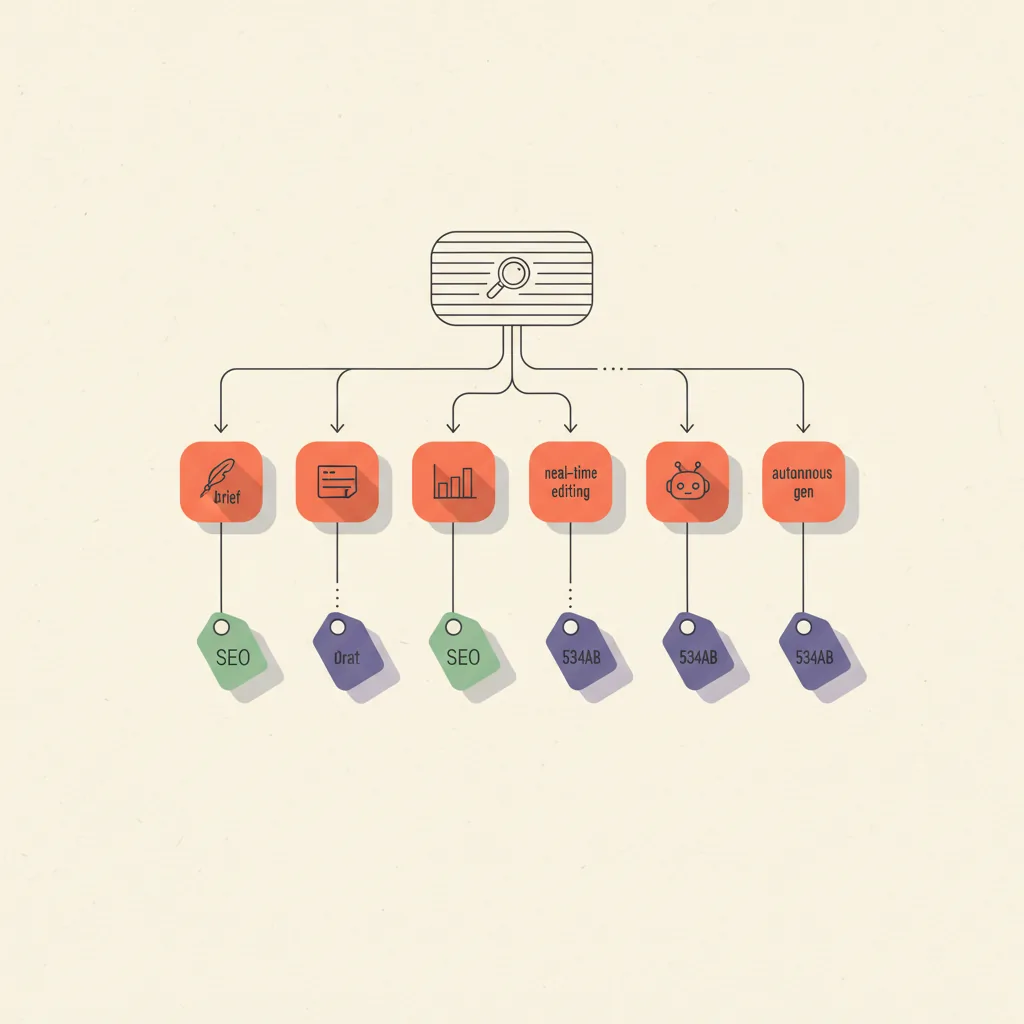
The five things SEO writing tools actually do
Pick the category before the product. The bundling that makes sense for a content marketing team running 40 articles a month makes the wrong stack for a solo operator running four.
| Category | Best pick | Pricing (Apr 2026) | When to choose |
|---|---|---|---|
| SERP scraping + content scoring | Surfer SEO | $89–$219/mo | You want a real-time editor that scores against top 10 |
| Entity coverage modeling | Clearscope | $199–$1,200/mo | Enterprise content with strict topical depth |
| Brief generation | Frase | $45–$115/mo | Volume briefs for freelancers or AEO research |
| All-in-one generation | Jasper or ContentShake | $59–$499/mo | Marketing teams needing one bundled tool |
| Cheap SERP scraping | NeuronWriter | $23–$97/mo | Solo operators and agencies on tight budgets |
| Raw draft volume | ChatGPT / Claude | $20/mo per seat | Anyone with a real brief and editorial discipline |
| Autonomous article gen | Outranking or SEO Writing AI | $59–$249/mo | High-volume programmatic SEO only — heavy review needed |
SERP scraping tools — Surfer, NeuronWriter, Outranking
This is the largest and most marketed category. The pitch: scrape the top 10 ranking pages for your keyword, surface the entities and headings they share, score your draft against that template in real time. The good ones make the rubric visible while you write. The bad ones encourage over-optimization and produce copy that reads like every other page on the SERP.
Surfer SEO — $89–$219/mo
- What it optimizes for — keyword density, term frequency, heading structure, word count, NLP entity coverage, all relative to the live top 10 SERP. Real-time editor with a content score from 0 to 100.
- Where it wins — the editor itself. Ergonomically the strongest in the category; suggestions update as you type, and the auditing flow on existing pages is genuinely useful for content refreshes.
- Where it loses — the AI Article generator at the top tier produces serviceable but generic drafts. The content score correlates with rankings loosely; treating it as a target produces over-optimized copy. Pricing climbs fast above the entry tier.
- Our take — worth it for in-house content teams running 10+ articles a month. Not worth it for solo operators or agencies running fewer than 5 — the editor convenience does not justify $89 over NeuronWriter at $23.
NeuronWriter — $23–$97/mo
- What it optimizes for — same SERP-scraping model as Surfer but at roughly a quarter of the price. Content editor, NLP entity coverage, internal linking suggestions, WordPress and Search Console integrations.
- Where it wins — the price. Solo operators and small agencies get 80% of Surfer's functionality at a fraction of the cost. Lifetime AppSumo deals show up periodically and drop the cost further.
- Where it loses — UI is clunkier. Less polished for client-facing presentation. Integrations are functional but feel two product cycles behind Surfer.
- Our take — the right pick for any operator who values the SERP-scraping rubric but cannot justify Surfer pricing. We recommend it more often than any other paid tool in this category.
Outranking — $59–$249/mo
- What it optimizes for — autonomous article generation guided by SERP analysis. Pitches itself as full first-draft automation: feed a keyword, get a 1,500-word article scored against the top 10.
- Where it wins — speed of first draft. For programmatic SEO at high volume, the workflow is faster than any of the editor-first tools.
- Where it loses — output reads like every other autonomously generated SEO article on the web in 2026. Heavy human review needed before any output is publishable. The "30 articles a month for $79" tier sounds like a deal until the editing time gets accounted for.
- Our take — over-promised in the marketing, under-delivered in production. We strip it out of client stacks more often than we add it.
Entity coverage tools — MarketMuse, Clearscope
This category is older than the SERP-scraping camp and uses a different model. Instead of templating against the live top 10, these tools build a topic graph from a much larger corpus and score drafts on entity density and topical depth. The rubric is heavier and harder to game; the trade-off is steeper pricing.
Clearscope — $199–$1,200/mo
- What it optimizes for — entity coverage relative to a much larger corpus than Surfer's top 10. Grading against A+ down to F. Cleaner integrations with Google Docs, WordPress, and major CMS platforms.
- Where it wins — enterprise teams writing in regulated or technical verticals (healthcare, finance, B2B SaaS). The entity model holds up better on deep topics where the top 10 SERP results are mostly noise.
- Where it loses — pricing. $199 a month for the entry tier and $1,200+ for teams. Hard to justify outside an in-house content team with budget.
- Our take — worth it for enterprise content marketing operations shipping 30+ articles a month. Outside that profile, the value gap versus Surfer or NeuronWriter is hard to defend.
MarketMuse — $1,500+/mo (typical landing)
- What it optimizes for — same entity-coverage thesis as Clearscope, with deeper topic-cluster modeling and content inventory features. Auto-generated briefs, competitive content gap analysis, topic authority scoring.
- Where it wins — content strategy at scale. The topic-cluster reporting is genuinely deeper than anything else in the category.
- Where it loses — priced for a market that no longer exists. When Clearscope sits at $199 and Frase covers brief generation at $45, the $1,500+ MarketMuse landing tier needs a reason to exist beyond enterprise procurement inertia.
- Our take — the most over-priced tool in this comparison. Excellent product, wrong price. We have not recommended it to a client in 2026.
Brief generation — Frase
A different problem entirely. Brief generation tools do not score your draft; they assemble research into a structured outline before you start writing. For an operator who writes their own drafts (or feeds a raw LLM with a structured prompt), this is often the highest-leverage piece of the stack.
Frase — $45–$115/mo
- What it optimizes for — research aggregation. Pulls top 20 ranking pages, extracts headings, common questions, and SERP-adjacent entities into a structured outline. Lighter editor on top.
- Where it wins — the brief generator is the cleanest in the category. Faster than building briefs by hand or wrestling with Surfer's Content Editor for the research piece. The People Also Ask integration is genuinely useful for AEO research.
- Where it loses — the AI writer add-on at the top tier is unremarkable. Use Frase for briefs, then write or generate the draft elsewhere.
- Our take — the studio default for any operator running their own content motion. We pair it with Claude or ChatGPT for the actual draft and skip the bundled writer.
All-in-one generation — Jasper, Writesonic, ContentShake
The most marketed category and the one most operators arrive at first. The pitch: one tool for keyword research, brief generation, content writing, SEO optimization, and publishing. The reality: bundled mediocrity at premium pricing, mostly justified by the marketing budget rather than the production output.
Jasper (with SEO mode) — $59–$499/mo
- What it optimizes for — branded marketing copy with SEO templates layered on top. Brand voice training, team collaboration, dozens of templates for landing pages, product descriptions, and ads.
- Where it wins — brand-voice consistency for marketing teams running mixed content (blogs, ads, email, social). The brand voice training is the strongest in the category.
- Where it loses — the SEO mode is a feature added to a writing tool, not a feature designed by SEO operators. Surfer and Frase out-perform it on SEO depth at every tier.
- Our take — fine for marketing teams that already use Jasper for brand copy and want SEO bundled. Wrong pick if SEO is the primary use case.
Writesonic / Chatsonic — $39–$499/mo
- What it optimizes for — high-volume content production. AI Article Writer 6.0 generates 1,500-word articles from a single keyword. Chatsonic is the conversational layer with web search.
- Where it wins — entry pricing is more accessible than Jasper. Decent for fast first drafts when paired with manual editing.
- Where it loses — output quality is generic. The "AI article" output is barely distinguishable from raw GPT-4o with no brief. Pricing balloons fast at higher tiers.
- Our take — skip. The cheap tier is no better than a $20 ChatGPT seat with a custom prompt; the expensive tier is no better than Jasper or Surfer.
ContentShake AI (Semrush) — $60/mo standalone
- What it optimizes for — bundled SEO research from Semrush plus AI generation. The pitch: keyword research and content production in one workflow tied to Semrush's data.
- Where it wins — the Semrush data integration. Topic ideas come pre-validated against real search volume and difficulty data, which is more than most all-in-one tools offer.
- Where it loses — the writing engine itself is undistinguished. The $60 monthly cost on top of a Semrush subscription adds up fast.
- Our take — defensible for teams already paying for Semrush who want a quick generation layer. Otherwise the bundled price is hard to justify against Frase plus a raw LLM.
The raw LLM path — ChatGPT, Claude, Perplexity with a real brief
The most under-rated path in 2026 is the simplest one: a $20-a-month LLM seat plus a structured brief. No content score, no SERP scraping layer, no autonomous generator. Just a strong brief, a model with web access or a Frase-generated outline, and editorial discipline on the output.
- ChatGPT Plus / Pro — $20–$200/mo. GPT-4o handles general SEO writing well; o3 is overkill for most blog content. Web search and the Deep Research mode are useful for citation grounding.
- Claude Pro / Max — $20–$200/mo. Claude 4.7 produces tighter prose than GPT-4o on long-form, with fewer hallucinations on factual content. Our default for any post above 1,500 words.
- Perplexity Pro — $20/mo. Strongest at research-heavy first drafts where citations matter. Less polished as a pure writing tool; we use it as a brief input rather than a draft generator.
The catch: this path requires real brief discipline. An operator who feeds "write a 1,500-word post on the best AI SEO tools" into Claude with no structure gets generic content. The same operator who feeds a 600-word brief with the angle, the entities to cover, the source quotes, and the structural outline gets a draft that needs lighter editing than any autonomous SEO tool produces. See how to build an AI content engine for the brief framework we use, and what is programmatic SEO for the volume version of the same pattern.
Pricing snapshot — every named tool, April 2026
All prices below are April 2026 list, sourced from each platform's public pricing page or current client billing. Annual discounts of 15–25% are typical; team-tier and enterprise pricing usually requires a sales call.
| Tool | Category | Entry tier | Typical landing tier |
|---|---|---|---|
| NeuronWriter | SERP scraping | $23/mo | $57/mo |
| ChatGPT Plus | Raw LLM | $20/mo | $20/mo |
| Claude Pro | Raw LLM | $20/mo | $100/mo (Max) |
| Perplexity Pro | Raw LLM | $20/mo | $20/mo |
| Frase | Brief generation | $45/mo | $115/mo |
| ContentShake AI | All-in-one | $60/mo | $60/mo |
| Outranking | Autonomous gen | $59/mo | $129/mo |
| Jasper | All-in-one | $59/mo | $125/mo |
| Writesonic | All-in-one | $39/mo | $99/mo |
| SEO Writing AI | Autonomous gen | $59/mo | $129/mo |
| Surfer SEO | SERP scraping | $89/mo | $219/mo |
| Clearscope | Entity coverage | $199/mo | $599/mo |
| MarketMuse | Entity coverage | $149/mo (Optimize) | $1,500+/mo (Premium) |
The decision matrix
A single named pick by operator profile. None of these is universally correct, but each is the studio default for a specific shape of content motion.
| Profile | Primary tool | Secondary tool | Annual budget |
|---|---|---|---|
| Solo operator, 4 posts/mo | Frase | Claude Pro | ~$780 |
| Agency, 10–20 posts/mo per client | NeuronWriter | Frase + Claude | ~$1,500 |
| In-house team, 10+ posts/mo | Surfer SEO | Frase for briefs | ~$1,700 |
| Enterprise content team, 30+ posts/mo | Clearscope | Frase + Claude Max | ~$3,800 |
| Programmatic SEO at scale | Raw LLM + custom pipeline | NeuronWriter for spot checks | ~$500 |
| Brand-led marketing team | Jasper | Surfer for SEO depth | ~$2,200 |
What we actually run for digicore101
We are not a 30-person content marketing team; we run a tight stack with leverage at the brief layer and editorial discipline at the output layer. The current setup as of late April 2026:
- Keyword research — DataForSEO MCP plus Tavily for citation grounding, run from a custom Node script. Replaces the keyword-research piece of every all-in-one tool above.
- Brief generation — a custom Claude script that takes the keyword research output and assembles a 600-word structured brief with the angle, entities, source quotes, and outline. Frase covers this for operators who do not want to maintain custom code.
- Draft writing — Claude 4.7 with the brief and PortableText helpers. Most posts go from brief to draft in under 20 minutes.
- SEO scoring — none. We do not run a content-score rubric on our own posts. The brief covers entity coverage; over-optimizing the score after the draft is finished produces worse copy, not better.
- Humanizer pass — a separate Claude pass that strips AI tells and tightens cadence. This is the highest-leverage editing step and the one most autonomous tools skip entirely.
Total monthly tooling cost for the content motion: under $80 across Claude Pro, Tavily, and DataForSEO credits. The leverage is in the brief and the humanizer pass, not in any single SEO writing tool. We build versions of this pipeline for clients as part of our AI Automation Audit and content engine builds — see content marketing operations for the full operator setup.
What is the best AI tool for SEO writing?
There is no single best AI SEO writing tool because the category covers five distinct problems and no product solves all five well. The closest thing to a universal pick is the brief generator plus raw LLM combination — Frase at $45/mo plus Claude Pro at $20/mo for any operator running their own content motion. Total $65/mo, covers research, brief generation, and drafting at quality that holds up against any $200/mo tier in this comparison.
For a single named SaaS pick: Frase is the most defensible "first AI SEO tool to buy" because brief generation is upstream of every other step and Frase clears the production bar at the lowest entry price. After Frase, the second buy depends on the volume bottleneck. Producing more drafts than the brief flow can keep up with? Add NeuronWriter for SERP scoring on each post. Running 30+ posts a month? Move to Surfer or Clearscope. Producing programmatic content at high volume? Skip every tool in this comparison and build a custom pipeline on the raw LLM API, scored against what an AI agent is rather than a SaaS rubric.
Common mistakes when buying AI SEO writing tools
Patterns we see in audits of broken content stacks:
- Buying for the autonomous generation pitch — committing to Outranking or SEO Writing AI on the promise of "30 articles a month" without budgeting the human review time those articles need. The articles ship; the rankings do not.
- Treating the content score as the goal — optimizing every post to a Surfer score above 80 and producing copy that reads like every other SEO sludge page on the SERP. Score is a rubric, never a target.
- Stacking three tools in the same category — running Surfer plus Clearscope plus NeuronWriter on the same content. The signals overlap; the cost compounds; the editorial gain is zero.
- Skipping the brief — feeding a one-line keyword into any of these tools and accepting whatever first draft comes back. The brief is doing 80% of the work in every workflow that produces ranking content.
- Buying MarketMuse without the team to use it — the topic-cluster features only pay off at enterprise content scale. Solo operators and small agencies pay enterprise prices for a workflow they will never run.
- Trusting the AI writer inside an SEO tool — the writers bundled into Surfer, Frase, NeuronWriter, and Outranking are all serviceable but never as good as a raw LLM with a real brief. The bundled writer is a convenience feature, not a quality feature.
Where this is heading
Movements worth tracking through the rest of 2026:
- The all-in-one generation category is consolidating. Jasper, Writesonic, Copy.ai, and the long tail of GPT-wrapper tools had ~40 named entrants in early 2025; expect 6–8 survivors by end of 2026 as raw LLM access prices drop and brand-voice features become commoditized.
- Brief generation is becoming the default leverage point. Frase, MarketMuse, and the next wave of brief-first tools will keep displacing the heavier all-in-ones. Expect aggressive pricing competition through 2026 in the $30–$80/mo range as new entrants chase the segment.
- AEO and answer engines are reshaping the rubric. SEO writing tools that score against the live top 10 SERP are scoring against a target that ChatGPT Search, Perplexity, and Google AI Overviews are reshaping in real time. Expect every tool in this comparison to add an "AEO mode" by end of 2026, most of them poorly executed at first.
- Entity coverage models are losing ground to context-window expansion. Clearscope and MarketMuse built their thesis on heavyweight entity graphs; with Claude and GPT context windows expanding past 1M tokens, feeding the full top 10 SERP plus a brief into a raw LLM is now competitive with the entity-graph approach at a tenth of the cost.
- The autonomous-article tier is hitting an editing-time wall. Outranking, SEO Writing AI, and similar tools sell volume at low per-article prices. The operator math always lands the same way: the saved generation time gets eaten by the editing time, and the saving is roughly zero. Expect this category to either ship genuinely better outputs or fade.
The pattern across all five: the teams two quarters ahead are not the ones spending the most on AI SEO writing tools. They are the ones who picked carefully at the brief layer, gave the raw LLM real structural input, and skipped the autonomous generators entirely. Replacement is a tactical move on a single line item; brief discipline is what changes the unit economics of the whole content motion.
We build these stacks for clients as part of our content engine work — see how to build an AI content engine for the full pipeline, what is programmatic SEO for the volume application, and our AI Automation Audit for the assessment that maps your current stack against the five categories above.