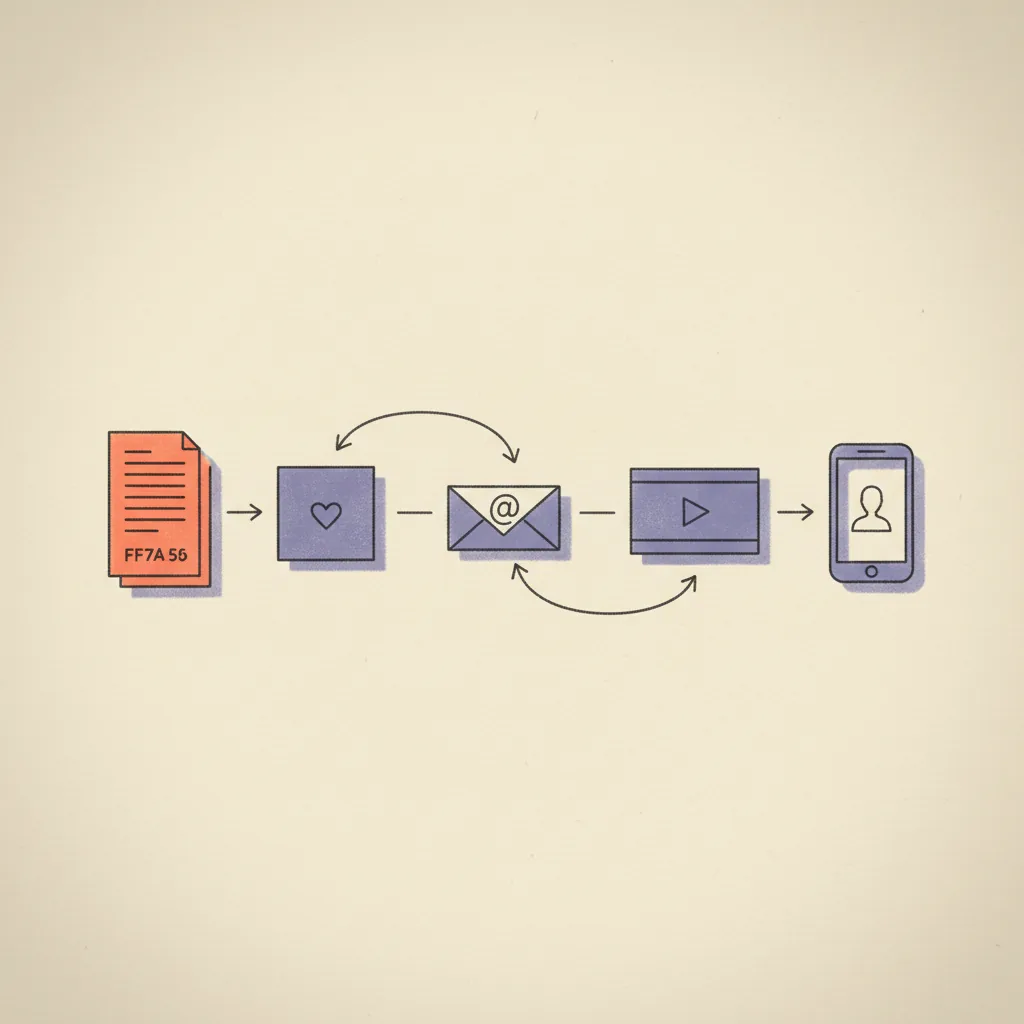
Most "how to build an AI content engine" guides describe one engine — usually SEO blog content — and call it the engine. There are five. Each one has a different format, a different distribution surface, a different brief shape, and a different way of failing. Treating them as one is what produces "AI content engines" that ship a hundred Medium-style posts and zero ranking pages.
The architecture is shared across all five (research → brief → draft → humanize → publish), but every other detail differs. This post maps the full set, walks each engine's specific tooling and constraints, and lays out the order most teams should build them in. The numbers and stack picks below are from active client billing and what we run for digicore101 itself in mid-April 2026.
The five platform engines
Each engine takes a different format, a different distribution surface, and a different brief structure. Conflating any two of them produces output that fits neither.
| Engine | Format | Distribution | Primary success metric |
|---|---|---|---|
| SEO / blog | Long-form 1,500–3,500 word structured articles | Google, perplexity, citation pickup | Ranked positions, organic traffic |
| Social organic | 280-char text + image, 60–90s vertical video | IG, TikTok, Threads, X, LinkedIn | Reach, follower growth, save rate |
| Email / lifecycle | Subject + body + behavior triggers | Resend, Klaviyo, ConvertKit | Open rate, click rate, conversion |
| Video / podcast | 30s Shorts to 60-min episodes | YouTube, Spotify, native video apps | Watch time, subscriber growth |
| Ad creative | UGC-style avatars, static creative variants | Meta, TikTok, YouTube paid | CTR, CAC, ROAS |

The shared architecture (works for all five)
Every engine ships the same five layers underneath. The format changes; the layers do not.
| Layer | Owns | Without it | Notes |
|---|---|---|---|
| 1. Research | What is worth saying, who is searching, what is already winning | You produce content nobody wants | Different research surface per engine: SERP for SEO, trending sounds for TikTok, subject-line tests for email |
| 2. Brief | Angle, structure, format constraints, success criteria | Generic output that competes with what already exists | The single highest-leverage layer across all engines |
| 3. Draft | Words, frames, voice, footage | Nothing else can run | Now a commodity; pick the cheapest LLM that handles your format |
| 4. Humanizer | Strip AI cadence, fit voice, fact-check | Output reads as AI slop, gets bounced | Different humanizer rules per engine — SEO needs voice, social needs rhythm, email needs subject-line lift |
| 5. Publish + measure | Ship, distribute, measure, feed back into research | You ship into a void | The feedback loop is what turns "AI tool" into "engine" |
The fastest way to think about this: layer 3 (the actual generation) was the entire job five years ago. Today it is roughly 15% of the work and getting cheaper every quarter. The competitive advantage moved upstream to research and brief, and downstream to humanization and distribution. Optimize the wrong layer and the engine produces the wrong output regardless of which platform you are on.
Engine 1: SEO / blog content
The classic engine — long-form articles that rank on Google and get cited by perplexity, claude, and chatgpt. Output unit is 1,500–3,500 word structured posts with H2 hierarchy, internal linking, FAQ schema, and citations.
- Research — DataForSEO SERP API ($0.001–$0.005/query) for top-10 + PAA + related searches; Tavily ($0.005–$0.05/call) for citation-ready facts. Optional Ahrefs Lite ($129/mo) for keyword volume validation.
- Brief — markdown template populated by Claude reading the research JSON. Specifies target keyword, angle, H2 outline, PAA verbatim, internal links, target word count.
- Draft — Claude API (Sonnet 4.6) producing structured PortableText output. ~$0.05–$0.15 per article.
- Humanizer — strip "stands as a testament" / em-dash overuse / parallel three-part lists; force concrete anchors per paragraph; remove meta-narration. Plan 15–20 editorial minutes per 2,500-word post.
- Publish — Sanity (free tier) → Astro static build → GSC measurement. Internal-link audit script weekly.
The engine you are reading about. Cheap stack runs roughly $50–$150 a month per writer-equivalent. See what is AI UGC and AI image generators compared as examples produced by this exact pipeline.
Engine 2: Social organic content
Per-platform format and rhythm constraints, with each platform demanding native voice. A LinkedIn post is structurally different from a TikTok script; an X thread is structurally different from an Instagram carousel. Cross-posting the same content with light edits is the failure mode that catches every team that thinks of "social" as one thing.
- Research — different per platform. TikTok and Reels: trending sounds + visual hooks (use Tokchart, Trendpop, or platform-native tooling). LinkedIn and X: real-time signal scraping (Phantombuster, Apify, or Exa search). Instagram: competitor carousel teardown.
- Brief — platform-specific templates. TikTok needs a 3-second hook + payoff structure. LinkedIn needs a hook + 3 supporting sentences + question close. Threads needs the rhythm of an X thread but with longer paragraphs.
- Draft — Claude or GPT for text; for video, the brief feeds an AI UGC tool (Arcads, Creatify, Higgsfield) for the avatar and a video model (Seedance, Veo) for the B-roll.
- Humanizer — different from SEO. Social needs rhythm, line breaks, and platform-native idioms. The "AI smell" on social is more about cadence than vocabulary; readers spot reflexive three-part structures within a swipe.
- Publish — Buffer, Hypefury, Typefully, or platform-native scheduling. For TikTok and Reels, the upload step is the bottleneck; native uploaders outperform third-party API uploads by ~30% on initial reach because the platforms favor their own apps.
Cheap stack: $30–$200 a month per platform you actively run. Expensive all-in-one platforms (HeyOrca, Sprout Social, Hootsuite) run $300–$1,500 a month and consolidate scheduling but rarely improve content quality. The leverage is in the per-platform brief layer, not the scheduler.
Engine 3: Email / lifecycle content
Email is the engine where AI generates the lowest-effort wins because the copy unit is short and the testing loop is tight. Subject line, preheader, body, CTA — each is a small enough surface to A/B test programmatically. Behavior triggers (opened/clicked/purchased/abandoned) are the real distribution surface; the writing is secondary.
- Research — historical send data (open rate, click rate, revenue per email per segment), competitor newsletter teardown (subscribe to 20 in your space, build a swipe file), customer language scraping (support tickets, reviews, sales-call transcripts).
- Brief — segment, behavior trigger, single conversion goal per email, the one piece of customer language to anchor on. Most B2B email AI failures come from skipping this layer and generating "weekly newsletter" content with no specific reader in mind.
- Draft — Claude or GPT producing subject + preheader + body. Output 5–10 subject-line variants per email and let the platform A/B test. Drafting is cheap ($0.01–$0.03 per email).
- Humanizer — different again. Email humanization is mostly about specificity (a real example, a real number, a real customer name where allowed) and cadence (short sentences, line breaks, plain-text feel). The AI tells in email are: stock subject-line patterns ("The X you didn't know you needed"), generic opening salutations, three-part promise structures.
- Publish — Resend, Klaviyo, ConvertKit, Loops. The platform decides distribution based on engagement scoring; quality of recent sends matters more than total list size.
We run our own email engine on Resend + Supabase + GitHub Actions. The full architecture is documented in building our sunset sequence. Cheap stack: $20–$100 a month for under 50k subscribers.
Engine 4: Video / podcast content
Long-form audio and video is the engine with the highest production overhead and the longest time-to-payoff. AI compresses two of the three big costs (scripting and editing) but cannot yet replace the third (the host or talent). Workflows are still hybrid: human host + AI everything else.
- Research — competitor channel teardown (Tubebuddy, VidIQ for YouTube), trending podcast topics (Listen Notes, Podchaser), audience question mining (Reddit subreddits, YouTube comments on adjacent channels).
- Brief — episode outline, segment structure, hook for the first 30 seconds, B-roll list, CTA. For podcasts, the brief plus a guest pre-call covers most of it. For YouTube, the thumbnail and title brief is as important as the script.
- Draft — Claude or GPT for scripts and show notes. AI video tools (Veo, Seedance, Sora) for B-roll. AI voice tools (ElevenLabs) for narration if you go fully synthetic. Most teams use AI for B-roll and human voiceover for anything that has to feel personal.
- Humanizer — for video, this is the editor cutting out filler, tightening pacing, and re-recording sections that sound scripted. For podcast scripts: Descript-style edit cuts and human delivery from a real host.
- Publish — YouTube + Spotify native uploaders. Repurposing is its own sub-engine — one 60-minute episode becomes 8–12 short clips, each fed back into engine 2 (social organic).
This is the most expensive engine to build. Cheap stack: $200–$500 a month plus host time. The realistic path: start with one episode a week, repurpose into 8 clips, feed those into the social engine. The repurposing layer is where most teams underestimate the volume math.
Engine 5: Ad creative content
Paid distribution is its own engine because the brief is fundamentally different — every output is graded by a paid algorithm within 48 hours, and the iteration count required to find a winner is 30–100 variants per concept. AI is uniquely strong here because variant generation is the bottleneck.
We covered this in detail in two existing posts:
- What is AI UGC — the synthetic creator-style video format that ships ad creative at 4x volume vs human UGC.
- Best AI video ad tools — Arcads, Creatify, MakeUGC compared on production-volume survival.
- AI image generators compared — Nano Banana, Midjourney, Flux, Ideogram for static ad creative.
- Cheapest AI video generation API in 2026 — Seedance, Veo, Sora pricing for B-roll and hero shots.
Cheap stack: $200–$500 a month for tools, plus the actual ad spend. The output is judged within 48 hours by Meta's and TikTok's ranking algorithms, which makes this the engine with the tightest feedback loop and the clearest ROI math.
The cheap stack vs the expensive stack
Most "AI content engine" SaaS pitches sell you a $300–$2,000 a month all-in-one platform that wraps the same components you can wire together for $50–$300 a month per engine. The math:
Running all five engines on the cheap stack: roughly $900 a month total. Running all five on the expensive stack: roughly $4,650 a month. Most teams overspend by 4–5x on tooling and underspend on editorial process. The leverage is in the brief and humanizer layers, not in the platform.
Build order: which engine first
The most common mistake is building the engine you find easiest, not the engine your business actually needs. The right first engine depends on where revenue currently comes from.
| Business shape | First engine | Second engine | Why |
|---|---|---|---|
| B2B services / consulting | SEO / blog | Email / lifecycle | Buyers research before booking; ranked content + nurture sequence is the tightest funnel |
| DTC / consumer product | Ad creative | Social organic | Paid is where DTC scales; organic is the moat once unit economics work |
| SaaS (PLG / self-serve) | SEO / blog | Email / lifecycle | Bottom-of-funnel keywords + activation drips compound the cheapest |
| Creator / personal brand | Social organic | Video / podcast | Audience growth on platform; long-form for depth and licensing |
| Agency / marketplace | SEO / blog | Ad creative | Authority for inbound; ad creative as a billable service |
| Enterprise / sales-led | Email / lifecycle | SEO / blog | Account-based nurture matters more than ranking; SEO is a long bet |
A reasonable build pace once you have picked the first engine: 2–3 weekends to wire layers 1 (research), 5 (publish), and the editorial calibration loop, then 4–8 weeks before output is consistently ranking, opening, or converting. Add the second engine after that loop is producing real distribution, not before.
What is the 10/20/70 rule for AI?
The 10/20/70 rule is a McKinsey and IBM framing for AI implementation cost allocation: 10% on algorithms, 20% on technology, 70% on people and process change. It is referenced often in AI strategy work because the people-and-process layer is where most enterprise AI projects fail, not at the model or the API.
Applied to any of the five content engines: spend roughly 10% of your effort picking the model (it barely matters; Claude or GPT both work), 20% on the technology stack (research APIs, CMS, integration glue, distribution platform), and 70% on the editorial process (briefs, humanization, internal linking or platform-native rhythm, measurement). Teams that invert this ratio — spending 70% on tooling and 10% on process — produce engines that look impressive on a demo and fail to perform in production.
How we run all five for digicore101
We run all five engines at different maturity levels in production today: the SEO/blog engine is fully built and shipping (every Knowledge and Blog post on this site goes through the pipeline described in engine 1, infrastructure in the digicore101-portal repo and Astro/Sanity stack); email/lifecycle is running on Resend + Supabase + GitHub Actions cron for welcome and sunset sequences; ad creative is actively building, with the AI Creative cluster and routing wired to Meta and TikTok; social organic is partial (LinkedIn and X with manual editorial — brief and draft layers are running, distribution scheduler isn't automated yet); video/podcast is the earliest stage, with scripting workflow in place but recording cadence still ad-hoc.
- SEO / blog — most mature. Every Knowledge and Blog post on this site went through the pipeline described in engine 1. The infrastructure lives in the `digicore101-portal` repo (research scripts, post helpers, Sanity seed) and the site repo (Astro routes, internal linking).
- Email / lifecycle — running. Resend + Supabase + GitHub Actions cron handles the welcome and sunset sequences. Documented in building our sunset sequence.
- Ad creative — actively building. The AI Creative cluster (AI UGC, best AI video ad tools, image generators) reflects the tools we use; the routing layer is wired to Meta and TikTok.
- Social organic — partial. We post to LinkedIn and X with manual editorial; the brief and draft layers are running but the distribution scheduler is not yet automated.
- Video / podcast — earliest stage. Scripting workflow exists; recording cadence is still ad-hoc.
What we have learned: the engines compound when they share research and brief data. A keyword cluster that wins on the SEO engine (e.g. "AI image generators") feeds the social engine (carousel teardowns of the same models), the ad engine (UGC scripts referencing the same comparisons), and the email engine (deep-dive sends to subscribers who clicked on the ranking post). Building each engine in isolation throws that compounding away.
Common failure modes
Six failure patterns show up consistently in audits of broken AI content engines, all of which are about process discipline rather than tool choice. Building one engine and calling it the engine misses 4 of 5 distribution surfaces. Skipping the brief layer (collapsing research and writing into one ChatGPT prompt) produces generic output regardless of platform. Cross-posting the same content across engines without rewriting reads as lazy and platform algorithms penalize the format mismatch. Skipping humanization gets caught regardless of platform — the tells differ, the result is the same. Generating without a feedback loop means re-running the same brief next week with no signal. Treating the engine as a one-time build (wire once, walk away) starves it of the weekly editorial input and quarterly review every engine actually needs.
- Building one engine and calling it the engine — the failure this post is meant to prevent. SEO-only or social-only engines miss 4 out of 5 distribution surfaces.
- Skipping the brief layer — collapsing research and writing into a single ChatGPT prompt. Output is generic regardless of platform.
- Cross-posting the same content across engines without rewriting — taking an SEO blog post and shipping it as a LinkedIn post or a Twitter thread without restructuring for the platform. The format mismatch reads as lazy and the platforms' algorithms penalize it.
- Skipping humanization — publishing untreated AI output in any channel. The tells are different per platform but readers spot all of them.
- No feedback loop — generating content without measuring what worked, then re-running the same brief shape next week. Engines need the publish layer to feed signal back into the research layer.
- Treating the engine as a one-time build — wiring it up once and walking away. Every engine needs weekly editorial input on briefs and quarterly review of what is performing.
Where this is heading
Four shifts will reshape AI content engine economics through the rest of 2026. Per-platform AI tooling is fragmenting, not consolidating — the "all-in-one content platform" pitch is fading because each engine has different optimization surfaces, and specialized tools per engine win. LLM draft quality has converged: Claude, GPT, and Gemini all produce competent drafts from a good brief, the model wars stopped mattering for content workflows around mid-2025 (pick whichever has the cheapest API and move on). Humanizer detection is becoming an arms race per platform — AI-detector tools, ad-platform classifiers, Google's SpamBrain, and platform-native AI flagging all improve monthly, so the humanizer pass needs to be a living per-engine skill not a one-time prompt template. Distribution feedback loops are the new moat: engines where research, brief, and publish layers share data turn one winning angle on one platform into briefs for the others within hours, not quarters.
- Per-platform AI tooling is fragmenting, not consolidating. The "all-in-one content platform" pitch is fading because each engine has different optimization surfaces. Specialized tools per engine win.
- LLM draft quality is converging. Claude, GPT, and Gemini all produce competent drafts from a good brief. The model wars stopped mattering for content workflows around mid-2025; pick whichever has the cheapest API and move on.
- Humanizer detection is becoming an arms race per platform. AI-detector tools, ad-platform classifiers, Google's SpamBrain, and platform-native AI flagging all improve monthly. The humanizer pass needs to be a living per-engine skill, not a one-time prompt template.
- Distribution feedback loops are the new moat. The engines that win are the ones where research, brief, and publish layers share data — a winning angle on one platform feeds briefs on the others within hours, not quarters.
The teams that are going to win the next two years of organic and paid distribution are not the ones with the biggest AI tooling budget. They are the ones with the cleanest brief layer, the most disciplined humanizer pass, and the cross-engine feedback loop that turns one piece of evidence into five pieces of distribution.
We build these engines for clients as part of our content marketing operations service. The full multi-engine setup pays for itself within 90 days for any team spending more than $5k a month on freelance content, social agencies, or content tools. See what is AI UGC for the visual layer of the ad-creative engine, and n8n vs Zapier for the workflow plumbing that ties the engines together.