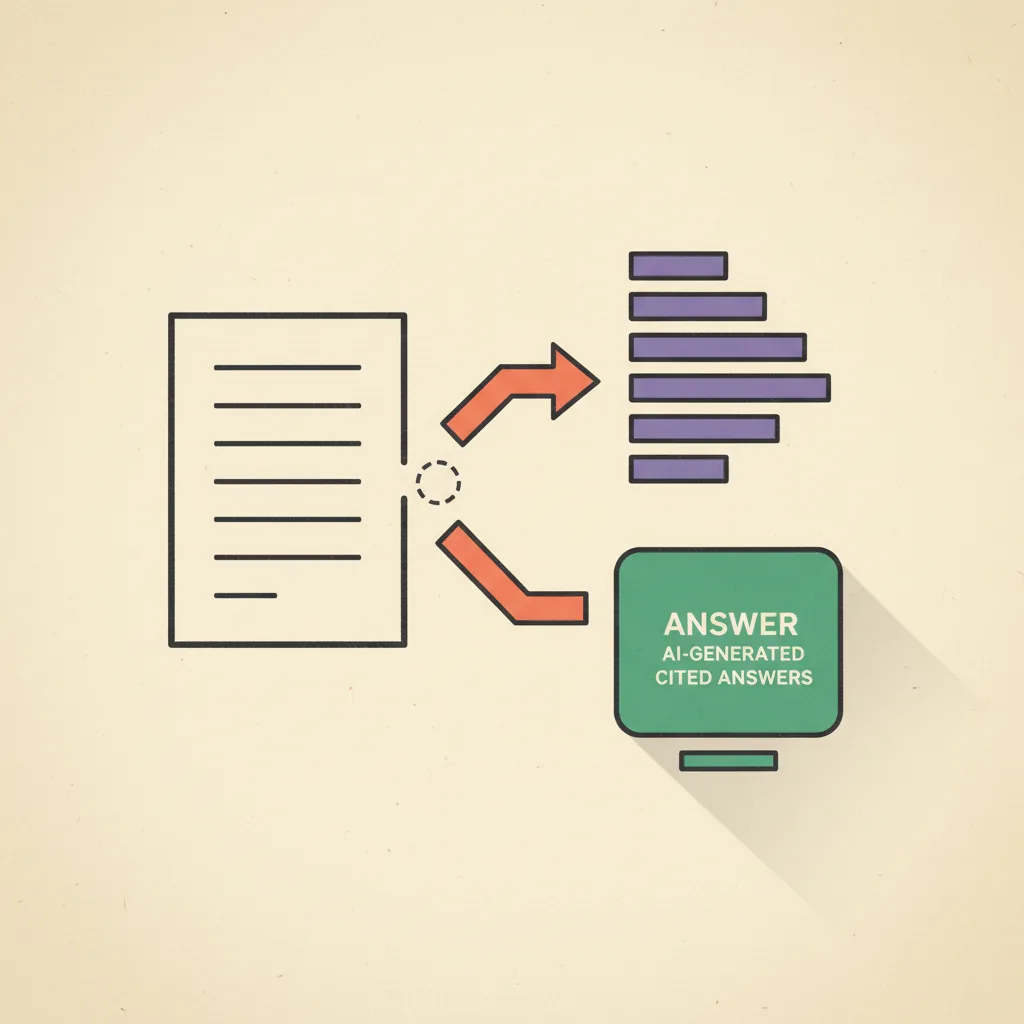
ChatGPT and Google's top-10 organic results agree only 14% of the time when processing the same query. Perplexity and Google agree 91% of the time. That single data point (GEO Alliance, April 2026) reframes the "AEO vs SEO" comparison more clearly than any framework comparison. If you are optimizing solely for Google rankings and assuming AI citation pickup will follow, you are correct for Perplexity and wrong for ChatGPT. And ChatGPT is now the fifth most-visited site on the internet, growing roughly one rank per month.
We run content programs across the AEO/GEO cluster for clients who need both channels — organic rank and AI citation pickup. The tactical differences between SEO and AEO are smaller than most guides suggest, but they are real and they matter at the margin. This post maps those differences with enough specificity to inform a content workflow decision without requiring a full program rebuild.
The 14% overlap problem — why one strategy is not enough
The 14% overlap between ChatGPT citations and Google top-10 results means that 86% of what ChatGPT considers a high-quality source on a given query is not the same as what Google considers a top-10 result. This is not a rounding error — it reflects genuinely different signal weights. Google's ranking model is calibrated against click behavior, backlink authority, and page-quality signals accumulated over two decades of search. ChatGPT's retrieval model is calibrated against training-data entity density, content coherence, and topical completeness: a partially different set of inputs.
Perplexity's 91% overlap with Google is the opposite story: Perplexity uses a traditional search retrieval layer as its candidate pool, then applies a synthesis model on top. This is why optimizing for Google rankings is sufficient for Perplexity but not for ChatGPT. The practical implication: if your content program only optimizes for Google, you have meaningful AEO coverage on Perplexity but limited coverage on ChatGPT, Claude, and AI engines that weight entity signals over backlink authority.
What SEO and AEO share — the common foundation
Most content that ranks well for SEO already contains the inputs AEO needs: the topic is covered accurately, the structure is clear, the page is crawlable, and the entity signals are present (named companies, specific numbers, referenced sources). This is the reason the "AEO vs SEO" framing overstates the divide — a well-written, deeply researched SEO post is 70–80% of the way to AEO-ready before any specific AEO optimization is applied. The remaining 20–30% is the AEO-specific work: PAA FAQ alignment, citable cluster length targeting, and schema validation. These are additions to an existing workflow, not a separate program. An operator who has published 20 well-researched knowledge posts already has the content foundation. The question is whether that foundation is being fully leveraged for both SEO and AI citation pickup, or only for one.
The shared signals that matter for both:
- Content accuracy and depth — both Google ranking models and AI extraction models penalize thin or inaccurate content. A page with outdated statistics or vague claims underperforms on both surfaces.
- Clear H2 structure — Google uses H2 headings as section anchors for featured snippets. AI extraction engines use them as question anchors for synthesis. Both reward H2 headings that name the specific question the section answers.
- Internal link structure — helps both Google's crawl graph and AI systems understand topic relationships and cluster authority. A post that links to its cluster siblings signals topical depth on both surfaces.
- Structured data (JSON-LD) — feeds Google rich results directly and feeds AI extraction indirectly by providing a machine-readable schema of the page's content type and structure.
- Content freshness — Google's QDF (Query Deserves Freshness) algorithm rewards recently updated content on time-sensitive queries. AI extraction models weight freshness at 3.2x for content updated within 30 days.
Where AEO and SEO diverge — the tactical differences
The divergences are real and specific. Understanding them prevents the two most common misallocations: spending on backlinks for AEO improvement (low return) or over-engineering FAQ schema when the content itself is thin (schema cannot rescue thin content). The table below maps the ten most common SEO and AEO tactics against their signal value for each program. Pay particular attention to the rows where one program shows high return and the other shows low or none — those are the budget allocation decisions that actually matter. The rows where both show high return are the shared foundation; they do not require a trade-off, they require priority.
| Tactic | SEO return | AEO return | Verdict |
|---|---|---|---|
| Backlink acquisition | High — core authority signal | Low — brand mentions matter more | SEO-specific |
| PAA-aligned FAQ sections | Low — minor on-page signal | High — single strongest AEO lever | AEO-specific |
| Content freshness (<30d) | Medium — crawl priority | High — 3.2x citation multiplier | Stronger for AEO |
| Citable cluster length (134–167w) | None — not a direct SEO signal | High — preferred extraction unit | AEO-specific |
| Page speed / Core Web Vitals | High — direct ranking factor | Low — crawlability matters, speed less | SEO-specific |
| Keyword density | Low — legacy signal, mostly obsolete | None | Neither — skip it |
| JSON-LD schema | Medium — enables rich results | High — required for reliable extraction | Stronger for AEO |
| Meta description length | Low — UX signal | None — AI does not use it | SEO-only, low priority |
| E-E-A-T signals (author, source) | High — trust and authority | High — entity grounding for LLMs | Both — highest priority |
| Third-party brand mentions | Medium — indirect authority | High — direct entity signal | Stronger for AEO |
The PAA gap — why it is the single biggest AEO opportunity
PAA (People Also Ask) questions represent the most specific, high-confidence signal in AEO optimization, and they are ignored by most SEO workflows. Traditional SEO keyword research targets the main query. PAA research surfaces the semantic sub-questions real users ask after seeing the main result — and these are exactly the questions AI answer engines are designed to resolve. When an AI Overview or Perplexity answer synthesizes a response to "what is AEO," it pulls from sources that directly answer the most common PAA sub-questions: "what is the difference between SEO and AEO," "is AEO replacing traditional SEO," "how do you optimize content for answer engines."
The implementation is mechanical: pull PAA for the target keyword using DataForSEO or any PAA scraper. Copy the exact question wording into the FAQ section. Answer each question in 2–4 sentences with specific detail. Validate the `FAQPage` JSON-LD block. This takes 30–60 minutes per post. The SEO impact is negligible (PAA coverage is not a ranking factor). The AEO impact is the single largest per-post lift available because you are matching the exact question format AI extraction engines prefer to cite.
Running AEO and SEO from the same content workflow
The practical architecture for operators who want both organic rank and AI citation pickup without maintaining two separate programs: one content brief, five additions to the workflow, zero additional budget. The five additions are not optional extras — they are the difference between a content workflow that captures one channel and a workflow that captures both. Each addition takes between 5 and 30 minutes per post to implement. The full set adds under 90 minutes to a standard content workflow. Run them in this order because each one sets up the next: PAA research informs the FAQ structure, FAQ structure informs the H2 headings, H2 headings determine where citable clusters need to land.
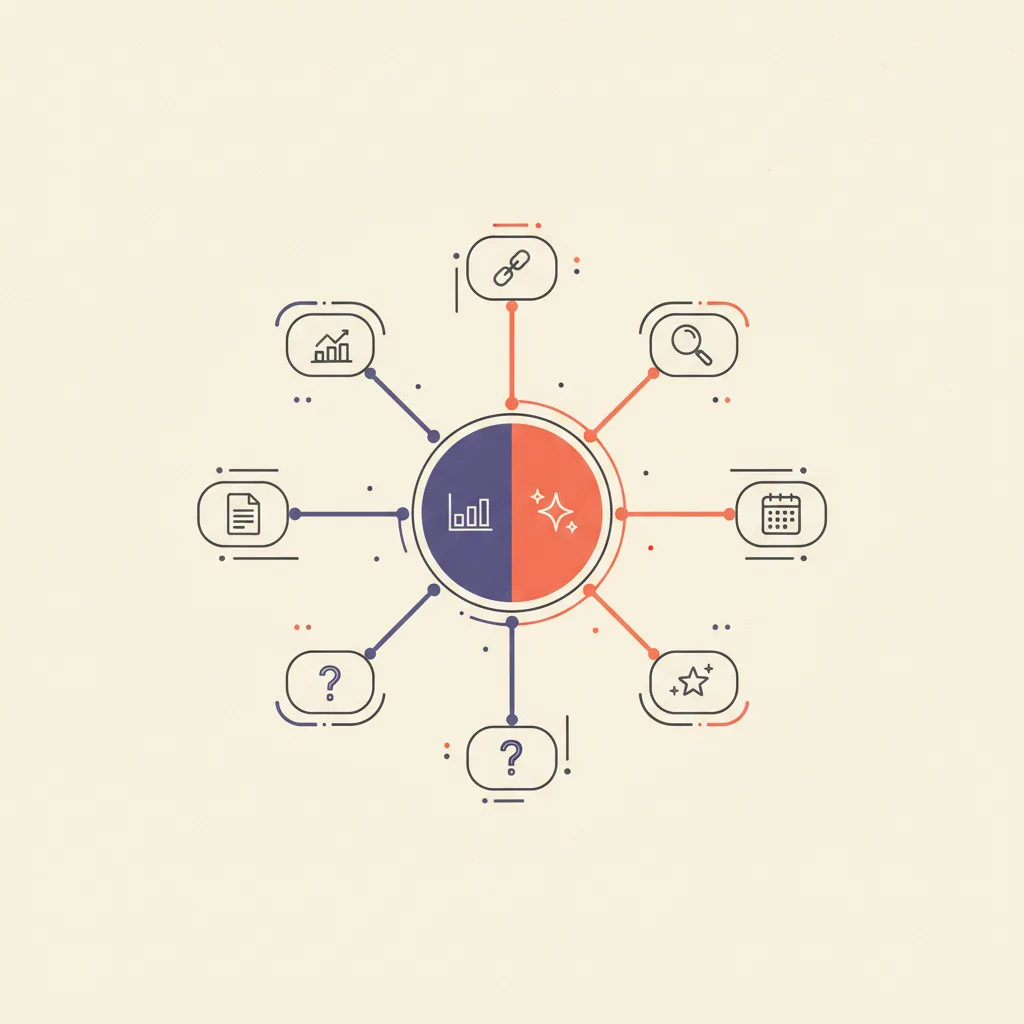
These five additions to a standard SEO content brief add roughly 45–90 minutes per post in workflow time. The return is citation coverage across Perplexity (which tracks Google rankings) and measurable improvement in ChatGPT and AI Overview citation pickup (which does not). For the AEO/GEO service we run at digicore101, these five moves are the first pass on any existing content base before any deeper optimization is considered. The chart above shows where each signal type lands on the SEO vs AEO impact matrix — schema fixes and PAA FAQ alignment are the clearest AEO wins; backlinks are the clearest SEO wins; citable clusters and internal links serve both. That distribution is the right guide for allocating time when you cannot do everything at once.
Which operators should prioritize AEO over SEO investment
The honest answer: most operators should not choose. The programs reinforce each other and run off the same content foundation. But when budget or bandwidth forces a priority call, the characteristics that favor AEO investment over additional SEO spend are worth stating clearly. If you are already on page one for your target keywords, additional SEO spend has diminishing returns — you are competing for rank position 1 vs position 2 when both get traffic. AEO spend at that point unlocks a new channel entirely: citation pickup at the 25–30% of queries where AI Overviews now appear and no click occurs. That is a different customer touchpoint, not a duplicate of existing traffic.
- High-consideration purchase — products or services where buyers research before buying and ask "what is X" or "how does X work" before "best X tool." AEO captures early-funnel consideration; SEO captures mid-funnel evaluation.
- B2B or coaching / professional services — buyers use ChatGPT and Perplexity for research at higher rates than B2C buyers. If the ICP is a marketing agency, DTC brand team, or professional operator, the AI search channels are where they research.
- Competitive organic landscape — if page-1 organic rankings are dominated by G2, HubSpot, Moz, and Semrush for every target keyword, AEO offers citation pickup at AI search platforms where that authority hierarchy is less deterministic.
- Content program already established — operators with 20+ published posts already have the foundation. Adding AEO moves to existing content delivers faster return than adding AEO signals to a thin new content base.
The inverse is also true: operators building a content program from scratch with no organic traction should prioritize SEO fundamentals first. AI citation pickup on a new domain with no crawl history is slow regardless of how well-optimized the individual posts are — the candidate pool filtering that feeds AI retrieval still draws on traditional authority signals. The practical minimum before AEO moves start returning: 10+ published posts in a focused topical cluster, at least 6 months of crawl history, and at least a few pages ranking in the top 20 organically. Before that threshold, AEO structural choices still belong in the content brief (they cost nothing to do at the draft stage), but they will not return measurable citations until the domain authority foundation supports them. What is AEO and generative engine optimization explained cover the foundational concepts in more depth. How to get cited by AI — the GEO/SEO guide covers the full implementation for operators ready to act.
| Operator profile | Recommended first priority | Why |
|---|---|---|
| New domain, <10 posts | SEO foundation — content depth and crawl history | AI candidate pools require domain authority; AEO moves have no leverage without it |
| Established site, page-1 rankings | AEO additions — PAA FAQ, schema, freshness | Foundation is solid; AEO unlocks a new citation channel without rebuilding content |
| B2B / professional services | AEO-first — ICP researches on ChatGPT/Perplexity | High-consideration B2B buyers use AI search at higher rates than B2C buyers |
| DTC / consumer brand | SEO-first — consumer search still Google-dominated | AI search share is lower for pure consumer queries; traditional SEO has higher return |
| Competitive SERP (G2, HubSpot dominate) | AEO — AI engines weight differently from Google | ChatGPT overlaps Google top-10 only 14%; authority hierarchy is less entrenched |
| Content already published (20+ posts) | AEO retrofit — apply PAA FAQ + schema to existing base | Zero new content required; AEO pass on existing posts is highest ROI move available |