
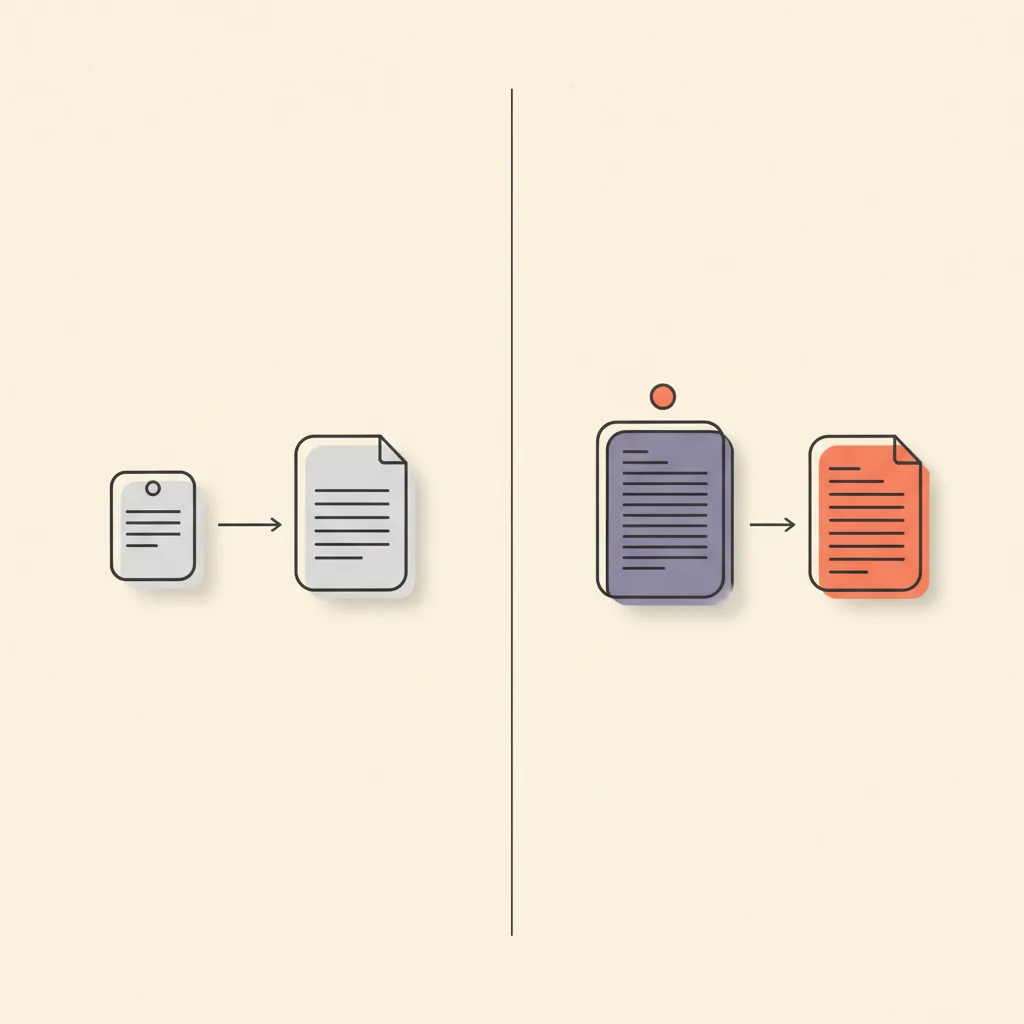
Most "AI content brief template" articles ship the same brief humans have written for a decade — title, primary keyword, audience, tone, H2 outline — with "AI tone of voice" stapled on as a new field. That is not an AI brief. That is a human brief with one extra row, handed to a model that has different failure modes than a human writer. The brief that actually produces good AI output is shaped around what the model gets wrong when left alone: it invents numbers, defaults to the median framing in its training data, repeats whatever Reddit said about the topic in 2023, and avoids any claim specific enough to be wrong. A brief built for AI has to neutralize each of those failure modes before the first draft prompt fires.
We ship Knowledge and Blog content for ourselves and for clients, and the brief is the artifact we spend the most time on. The post that gets shipped is downstream of a 1.5–2x longer brief that pre-loads the angle, the anchors, the inversion, the ban-list, and the validation checks. This post covers what goes into that brief and why AI needs each field. We are not shipping our internal prompts — those stay in-house. The field structure is the part that helps you, and it is the part most templates skip.
Stage 0 — Research inputs
Before any field of the brief gets populated, the brief itself has to be fed. Stage 0 is the research dossier the brief is built on. Most teams skip this and let the model "research" inside the prompt, which is how you end up with three-year-old stats and competitor names that no longer exist.
What goes here: the SERP for the target keyword (top 10 organic results, who they are, what shape they take), People Also Ask questions verbatim, related searches, and a teardown of the top three ranking pages — what they cover, what they skip, what their angle is. We pull SERP data via DataForSEO or Ahrefs, then read the top three results manually. AI cannot do the manual read because it cannot tell when a vendor page is laundering marketing copy as advice; a human can.
Why AI needs it: without the SERP teardown, the model writes against an imaginary average competitor. With it, the model writes against a specific gap — "the top three all rank with 12-field templates, none of them mention what AI is bad at, that is the wedge". Without PAA verbatim, the FAQ section gets paraphrased questions that miss the literal AEO match. Without related searches, the body never weaves in the semantic siblings that signal topical depth to Google.
Stage 1 — Angle and thesis
This is the field most templates do not have at all. The angle is the contrarian frame, the inversion, or the specific point of view the article will pivot on. It answers: what do the existing top-ranking posts get wrong, and what is our one-sentence rebuttal? Without it, the model produces "10 things to know about X" by reflex, because that is what most of its training data looks like.
What goes here: a one-sentence thesis, two to three sentences of justification (why the existing framing is wrong, what the operator-side reality actually is), and a "what we are not arguing" guardrail so the model does not over-rotate into clickbait contrarianism.
Why AI needs it: large language models default to the median framing in their training data, which is whatever the most-cited article on the topic argued three years ago. For SEO content that ranks, the median framing is exactly what the top three results already wrote. Without an explicit angle field, the AI politely competes with them on the same playing field and loses.
| Field | Thin brief (most templates) | Sharp brief (what AI actually needs) |
|---|---|---|
| Topic | AI content briefs | AI content briefs |
| Angle | "Explain how to write AI content briefs." | "The brief is not the input to AI. It is the output of a research step that itself runs on AI. Most templates ship a human brief with one tone field added — that is the wrong artifact." |
| Why we are right | (blank) | Top three SERP results all ship 10–14 field generic templates. None of them address what AI is bad at without specific anchors. That is the gap. |
| What we are not arguing | (blank) | We are not arguing humans should not write briefs. We are arguing the AI brief is structurally different from the human brief. |
| Predictable AI output | Generic 10-field listicle indistinguishable from rank 5 already | Specific argument that the model can defend with anchors instead of platitudes |
Stage 2 — Anchors
Anchors are the specific facts the article has to contain — numbers, prices, dates, named tools, named companies, named methodologies. They are the things the AI cannot invent without lying. If the brief does not pre-load them, the model fills the gap with plausible-sounding fiction, and the article reads correct but is actually hallucinating its way through every quantitative claim.
What goes here: a flat list of every anchor the article will reference, with source. "Claude Sonnet 4.7 priced at $3 input / $15 output per million tokens, source: Anthropic pricing page, accessed 2026-04-28." "DataForSEO SERP API: $0.0006 per query, source: DataForSEO pricing." Each anchor gets sourced or it does not go in the brief, because if we cannot cite it the model definitely cannot.
Why AI needs it: this is the failure mode that ends most AI content programs. The model writes confident sentences with made-up numbers — "GPT-4 costs roughly $0.06 per 1,000 tokens" when the actual price is something else, or a tool that was renamed last year referenced under its old brand. AEO surfaces and Google quality raters punish this hard. The fix is not better prompting; it is feeding the model the anchors as input so it has nothing to invent.
- Pricing anchors — every dollar figure in the article must trace to a sourced field on the brief. If we cannot source it, we cut the claim or rewrite it as a range with explicit caveat.
- Date anchors — every "as of" or "in 2026" claim needs a date the brief was researched. Stale anchors rot articles faster than anything else.
- Named-tool anchors — every product name we mention with a feature claim. Tools rebrand, features ship and unship; the model does not know.
- Named-company anchors — same logic for companies, especially in fast-moving categories like AI agents and content tools.
- Methodology anchors — any framework cited (10/20/70 rule, jobs-to-be-done, AIDA) gets sourced to its origin so we can attribute correctly.
Stage 3 — Outline
The outline is the H2 and H3 structure with a word-count band per section and a visual cadence plan. Most templates ship just the H2 list, which produces evenly-weighted articles that read like spec sheets. Real articles weight some sections heavier than others, and the brief is where that weighting decision gets made.
What goes here: each H2, the sub-H3s under it, a target word band (e.g. 200–350 words for a connective section, 400–600 for a load-bearing one), and a visual marker for where charts, figures, callouts, and tables fall. We plan visuals at the outline stage so the bottom half of the article does not run dry — the rule we follow is no three consecutive H2s without a visual.
Why AI needs it: ask a model for "an outline" and it returns eight equally-sized H2s, because that is what its training data optimized for. Ask it to draft against an outline that already specifies "this section is 150 words, that section is 600", and the output respects the weighting. The visual cadence plan also forces the brief to budget for figures and charts up front rather than retrofitting them after the draft, which is what produces those bottom-heavy posts that exhaust the reader.
| Word band | Section role | Use for |
|---|---|---|
| 100–200 | Bridge / transition | Closing one stage, opening the next; do not put load-bearing claims here |
| 200–350 | Connective explanation | Explaining a concept the reader needs to follow but not the post's main argument |
| 400–600 | Load-bearing argument | The H2s that carry the post's thesis; this is where most of your anchors land |
| 600–900 | Deep-dive section | Used sparingly — usually only for the one H2 that justifies the contrarian frame |
| Visual after | Marked on outline, not retrofit | A figure, chart, callout, or table planned at this break to maintain cadence |
Stage 4 — FAQ
The FAQ section is not "questions the writer thought were interesting". It is the People Also Ask questions from the SERP, used verbatim. This is the highest-leverage AEO move per post because Google treats PAA questions as semantic siblings of the main query — exact-match wording wins those slots in AI Overviews and rich snippets.
What goes here: 4–6 questions sourced from PAA verbatim, each paired with a 2–4 sentence answer the brief drafts ahead of time. If PAA returns empty for the keyword (which happens for narrow long-tail topics), we substitute the closest variants from related searches with question phrasing applied. Either way, the wording is sourced from the SERP, not invented.
Why AI needs it: ask a model to write FAQ questions cold and it produces what it thinks the questions should be, which is correlated with but not identical to what searchers actually ask. Pre-loading the questions verbatim removes that distortion. The model still drafts the answer, but the question wording — which is the thing Google matches on — is locked.
Stage 5 — Internal links
The internal-linking field is where the brief tells the model which sibling and parent pages on the site to weave into the body. Without it, AI either omits internal links entirely (most common failure) or invents URLs that do not exist (next most common). Both end the post's job as a cluster contributor.
What goes here: the cluster anchor (the parent post the article reports up to), 2–3 sibling posts in the same cluster, the primary CTA solution or service page, and 1–2 supporting cross-cluster links where natural. Each link gets the exact display text and the URL — no slug guessing. We list them in the brief; the model places them in the body.
Why AI needs it: the model has no idea what is on your site. Even with a sitemap in context, it tends to invent slugs that "would make sense" rather than linking to what actually exists. The brief solves this by making the link list a populated field instead of an inference task.
- Cluster anchor — the parent how-to or what-is post the article reports up to. Linked once, usually in the opener or the closing section.
- Sibling posts — 2–3 other posts in the same cluster. Linked at the natural semantic moment, not in a "related posts" appendix.
- Primary CTA — the one solution or service page the article should drive to. Linked at least once in the body, plus in relatedSolutions.
- Cross-cluster supports — 1–2 links to adjacent clusters when context warrants. Skip rather than force.
Stage 6 — Voice and ban-list
Voice is the field most templates have, but most do it wrong — they list "professional, friendly, direct" and call it done. That is not a voice spec; that is the description of every other vendor's voice spec. Real voice direction is a ban-list of phrases the model will reach for if not stopped, plus a hook-pattern assignment for the opener.
What goes here: the explicit ban-list (we maintain a standing list of LLM tells: "delve into", "tapestry", "in the world of", "navigate the landscape", "unlock", "seamless", "stands as a testament", "in today's evolving landscape" — and we add to it whenever we spot a new tic), the hook pattern for the opener (contrarian thesis, frame inversion, confession + outcome, counterintuitive number), and one or two paragraphs of voice direction grounded in our actual writing — not abstract adjectives.
Why AI needs it: the model has been trained on millions of marketing blog posts that sound the same, and its default register is the median of that corpus. Without an explicit ban-list, those phrases reappear in the draft like weeds. The hook-pattern assignment is the other half — without it, the model defaults to "In today's fast-moving AI landscape…" which fails the first-paragraph test instantly.
| Banned phrase (delete on sight) | Hook pattern (assign one) | When the pattern fits |
|---|---|---|
| "delve into" | Contrarian thesis | Big-picture how-to where everyone else has the framing wrong |
| "in today's evolving landscape" | Frame inversion | Comparison content where the surface ranking misses the actual decision |
| "unlock the power of" | Confession + outcome | Field-notes or playbook posts with a real client number to anchor on |
| "navigate the landscape" | Counterintuitive number | Pricing or performance posts where the spread itself is the headline |
| "stands as a testament to" | (rotate, do not reuse) | If the last three posts in the cluster used pattern X, this one uses Y |
Stage 7 — Validation checks
The last stage of the brief is the post-draft checklist. After the model produces a draft against the brief, this is the field that says: before this ships, a human verifies these specific things. It is not a generic "proofread it" check — it is a list of the failure modes specific to AI drafts.
What goes here: every anchor verified against its source, every internal link clicked to confirm it resolves, every ban-list phrase grepped for, the FAQ wording compared to the PAA source for verbatim match, the visual cadence checked (no three consecutive H2s without a visual), and a first-paragraph re-read to confirm it hooks rather than sets up.
- Anchors verified — every number, price, date, tool name, and company name traced back to its source field on the brief and confirmed against current reality.
- Internal links resolve — every link in the draft clicked through; broken or invented URLs caught here, not by the reader.
- Ban-list grep — search the draft for every phrase on the standing ban-list; rewrite any hits.
- FAQ wording matches PAA source — verbatim or near-verbatim; if the model paraphrased, restore the original.
- Visual cadence honored — no three consecutive H2s without a visual; the bottom half of the post is not a wall of text.
- First paragraph re-read — does it hook with a specific claim, number, or contrarian frame? Or does it set up what the post is about? Setup paragraphs get cut.
- Voice tells — does any paragraph still read like a press release? Rewrite that paragraph by hand.
- Cluster fit — does the post link up to its anchor and across to its siblings? Are the relatedSolutions correct?
Validation is where we catch what the brief and the model missed together. We do not ship anything that fails validation — we send it back through one more revision pass, with the specific failures noted on the brief for next time. The brief is a living artifact, not a one-shot input.
What this brief structure is not
Two clarifications, because every "AI content brief" article we audit hand-waves these:
- Not a prompt — the brief is upstream of the prompt. The prompt is the operating instruction we hand the model; the brief is the populated artifact the prompt references. A good prompt with a thin brief still produces bland output. A weak prompt with a rich brief produces something usable. The brief carries more weight than the prompt.
- Not "the human brief plus tone of voice" — most templates we see take the standard human brief and add a "tone" field. That is not the AI-shaped brief. The AI-shaped brief is structured around the model's failure modes (anchor invention, median framing, AEO miss, link hallucination, voice tells), not the human writer's information needs.
We build content engines and content briefs as part of our content marketing operations work. The cluster anchor for the broader topic of running AI content systems is how to build an AI content engine, and the related Knowledge posts on programmatic SEO and the best AI SEO writing tools cover adjacent surfaces of the same operator-side question. For teams that want the full audit of where AI fits in a content workflow, our AI Stack Audit is the right starting point.